The Butcher Singlet: A Short History of the Most Dangerous Garment in Wrestling
The butcher wrestling singlet has a wild history — from vaudeville strongmen to lucha libre icons. Here's where it came from and why LED Queens brought it back.
And why LED Queens brought it back
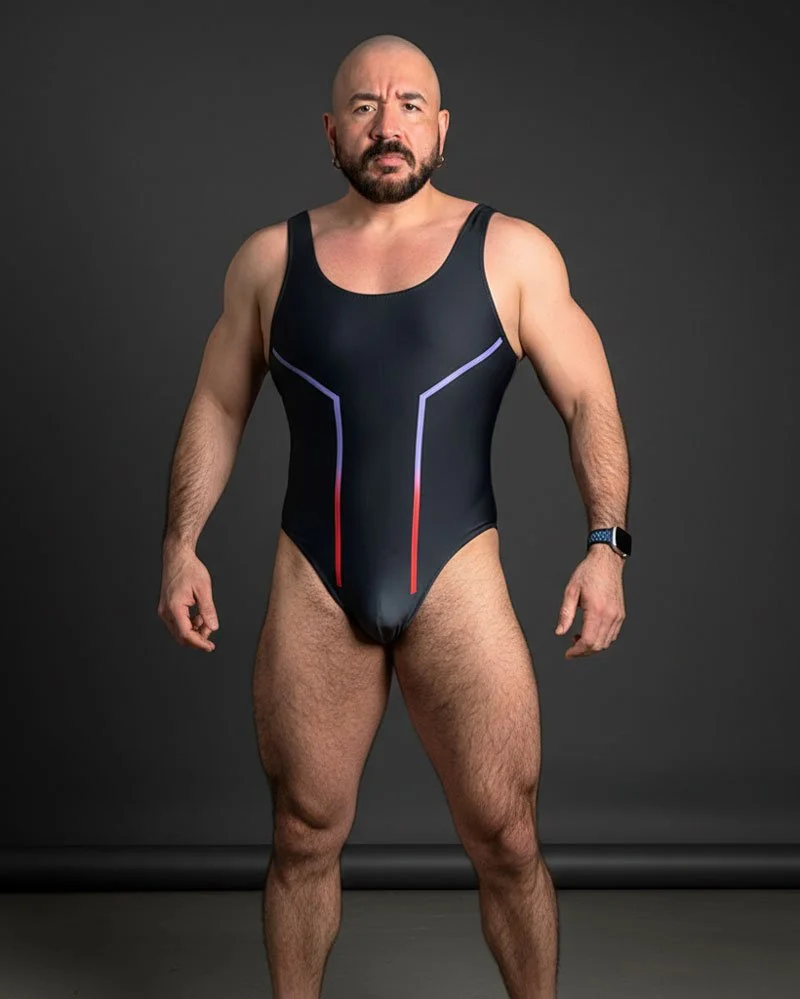
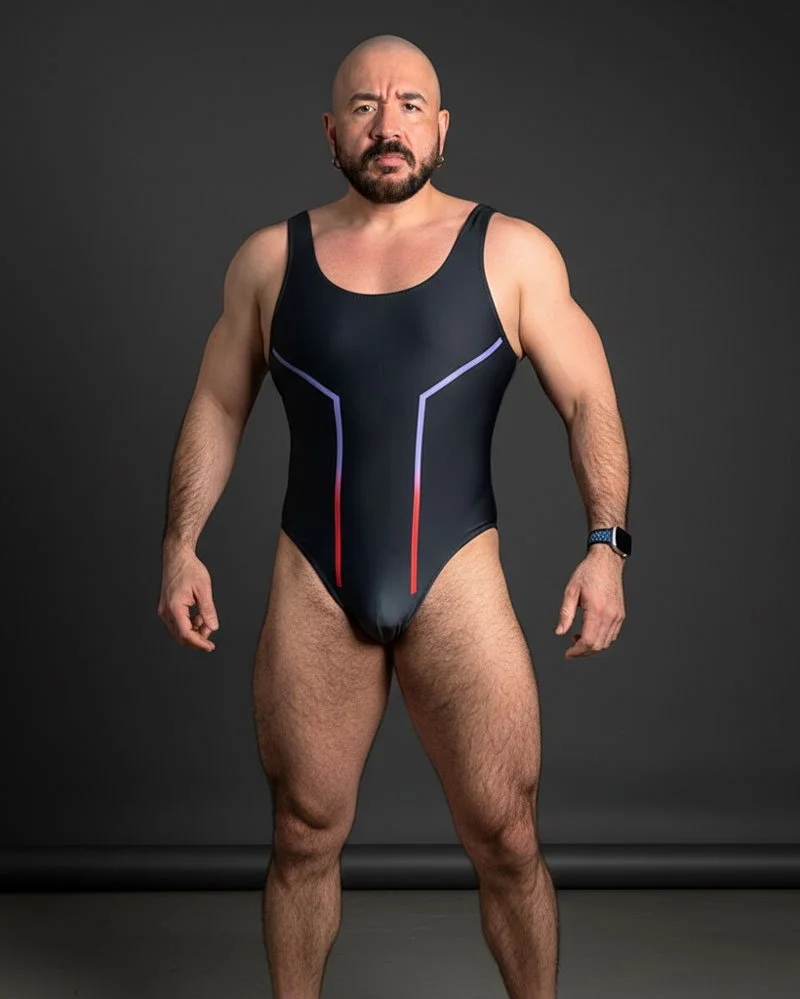
There is a moment, just after you pull the straps over your shoulders and feel the spandex stretch against your body, when you understand exactly what the butcher singlet is for. It is definitely not for modesty. The butcher singlet is for confrontation against your opponent. It's a bold serve: cut high at the hip and tight across the chest while leaving the back exposed. It leaves nothing to hide behind. The butcher singlet turns you into a weapon of spandex fetish and muscle power.
The history of how the butcher singlet got its name is, like most things worth knowing in professional wrestling, not entirely clean. What is clear is that the butcher singlet belongs to a specific lineage of wrestler — the heel, the villain, the rudo in the crowd came to hate and couldn't stop watching. Where the amateur wrestler wore his singlet as a uniform of discipline, the butcher wore his as a provocation for a march. The high cut also reveals the bulge, glutes, quads and hamstrings in a way that a regular singlet can't. In that sense, the butcher singlet indeed is made to slay.
The Evolution of the Iron Athlete: From Strongman to Superstar
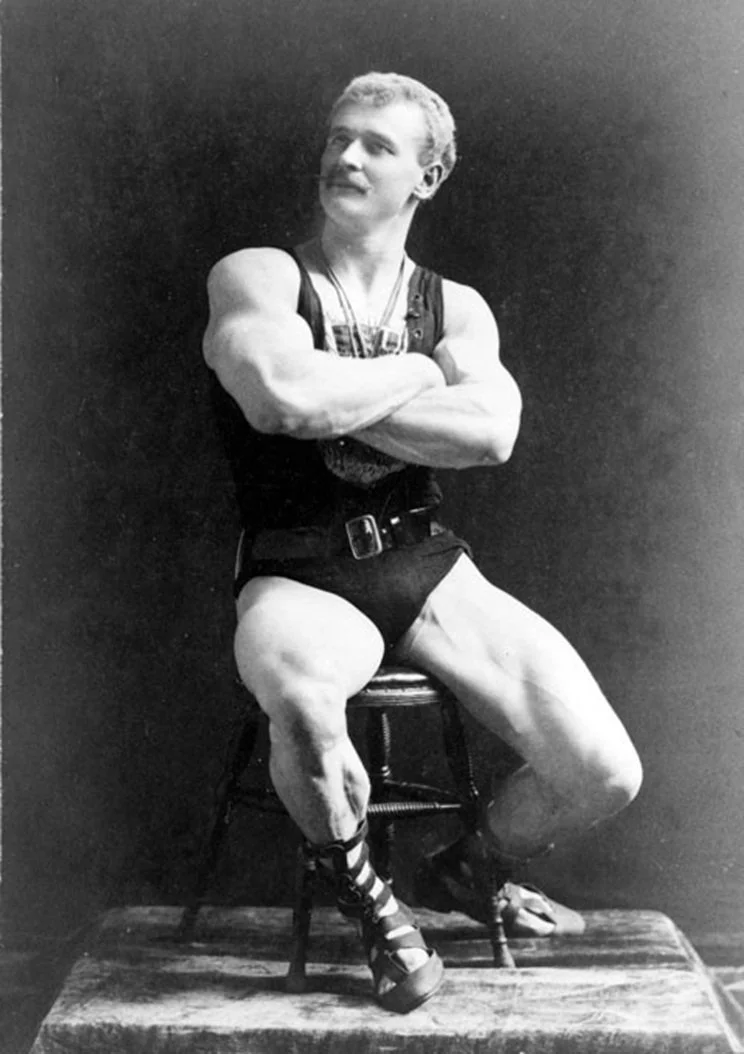
The lineage of the wrestling singlet begins on the vaudeville stage. In the late 19th and early 20th centuries, "strongmen" like Eugen Sandow and George Hackenschmidt needed garments that provided maximum range of motion while showcasing the muscularity that was their primary draw. These early "leotards" or "wrestling suits" were often made of heavy wool, featuring deep-cut armholes and a high-cut leg to allow for deep squats and overhead presses. As wrestling transitioned from a legitimate test of strength to the televised spectacle of the mid-20th century, these functional garments evolved into the "pro singlet"—swapping wool for shimmering spandex and bold, sublimated patterns that could be seen from the back row of a smoky arena.
The Emergence of the "Butcher" Aesthetic
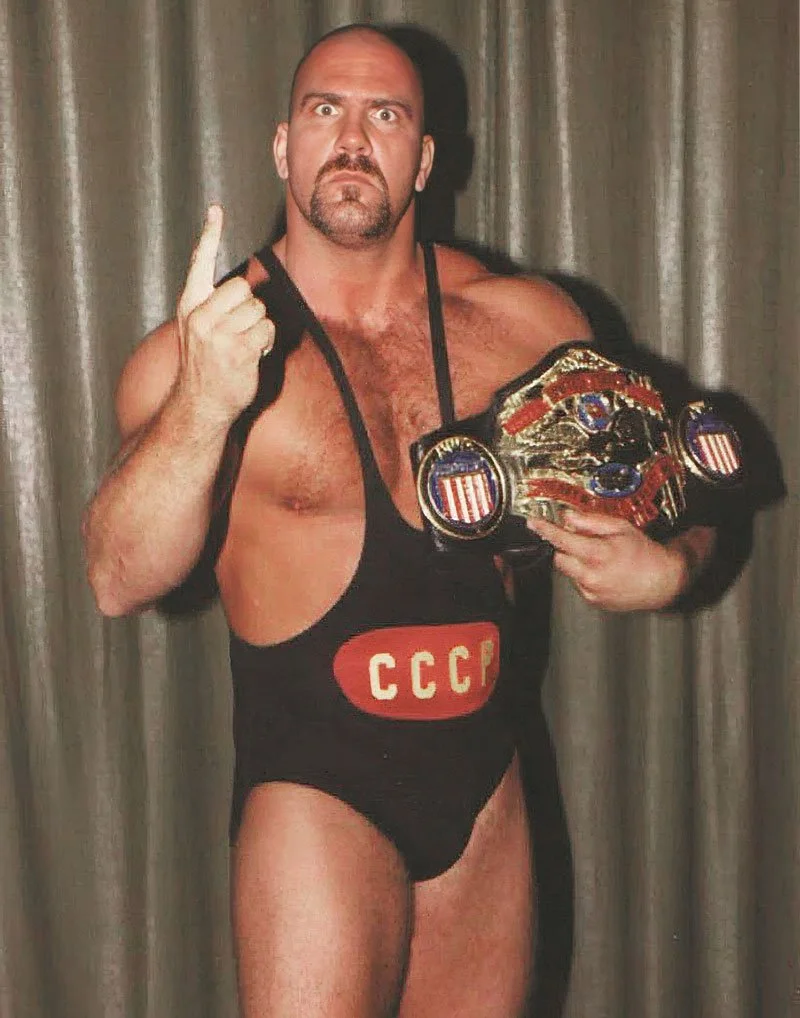
Pro wrestling superstar Nikita Koloff (https://en.wikipedia.org/wiki/Nikita_Koloff)
The specific "Butcher" style—defined by its deep-scoop neck and aggressive vertical stripes—emerged as a solution for the "big men" of the 1970s and 80s pro wrestling stars. Unlike the modest, high-neck singlets of amateur wrestling, this cut was designed to emphasize the "V-taper" of a powerhouse's back and lats. The vertical straps became a visual shorthand for raw, industrial toughness, mimicking the aprons of old-world tradesmen or the straps on the apron of your local butcher. This look signaled to the audience that the wearer was a tough a brawler. It was the uniform of the "Super-Heavyweight," built for the blood-and-guts era of Jim Crockett Promotions and the AWA.
The Modern Legacy: Why the High-Cut Endures
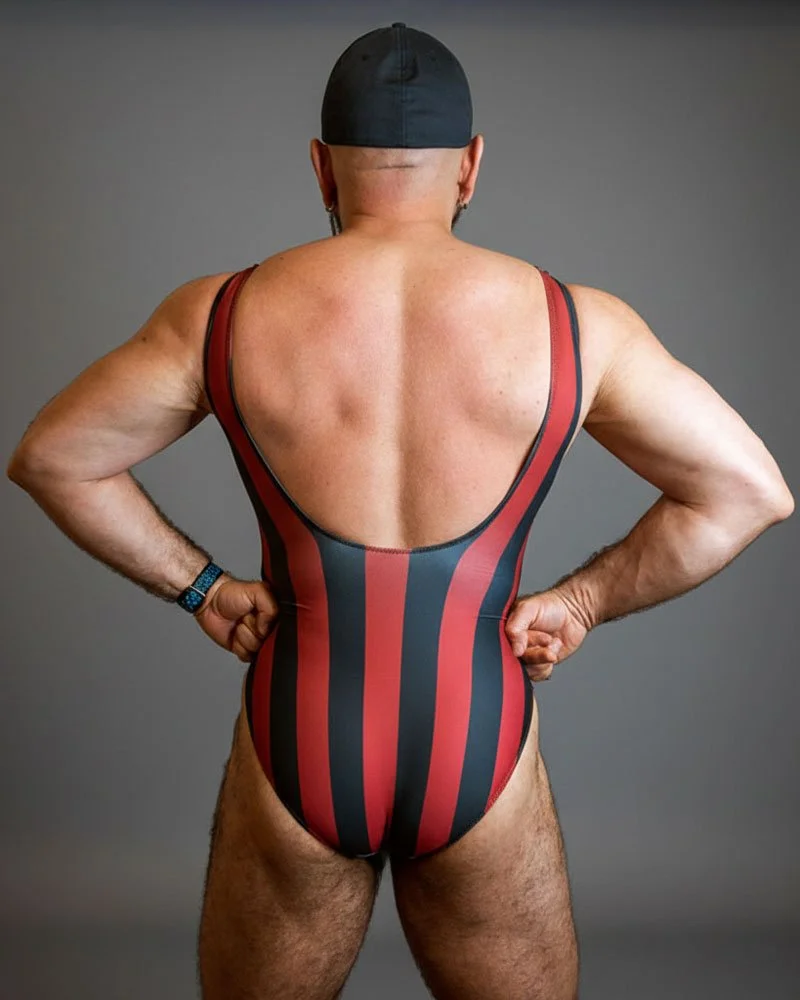
Today, this high-cut singlet has transcended the ring to become a staple of queer fashion, as well as spandex and wrestling fetish. The design persists because it is mathematically the most flattering cut for an athlete's physique—the high leg line elongates the lower body, while the deep side-cuts prevent the "boxy" look common in standard gym wear. By reclaiming this 80s aesthetic, brands like LED Queens are tapping into a "retro-aggressive" movement that also reclaims this garment for queer and gay communities. It’s a nod to a populist sport that has always entertained us with drama, muscle and theater, but one which also appeals intrinsically to those of us who love wrestling and spandex gear as part of our identities.
The "Striped & Scalloped" Honor Roll
Here is a thorough list of the pro wrestlers and luchadores who defined or currently rock the deep-cut, striped, or "Butcher-style" singlet:
Nikita Koloff: The "Russian Nightmare" who mastered the powerhouse singlet look to highlight his incredible traps and lats.
Andre the Giant: The late WWF superstar wore a black single-strap butcher.
Lucha Libre Icons:
Casandro: the most famous of all the “exoticos”
Modern Era:
Otis (WWE): Keeps the "Big Man" striped singlet tradition alive with a classic brawler vibe.
Ryback: His "Big Guy" singlets were a direct 2010s evolution of the 80s airbrushed style.
The LED Queens Relaunch
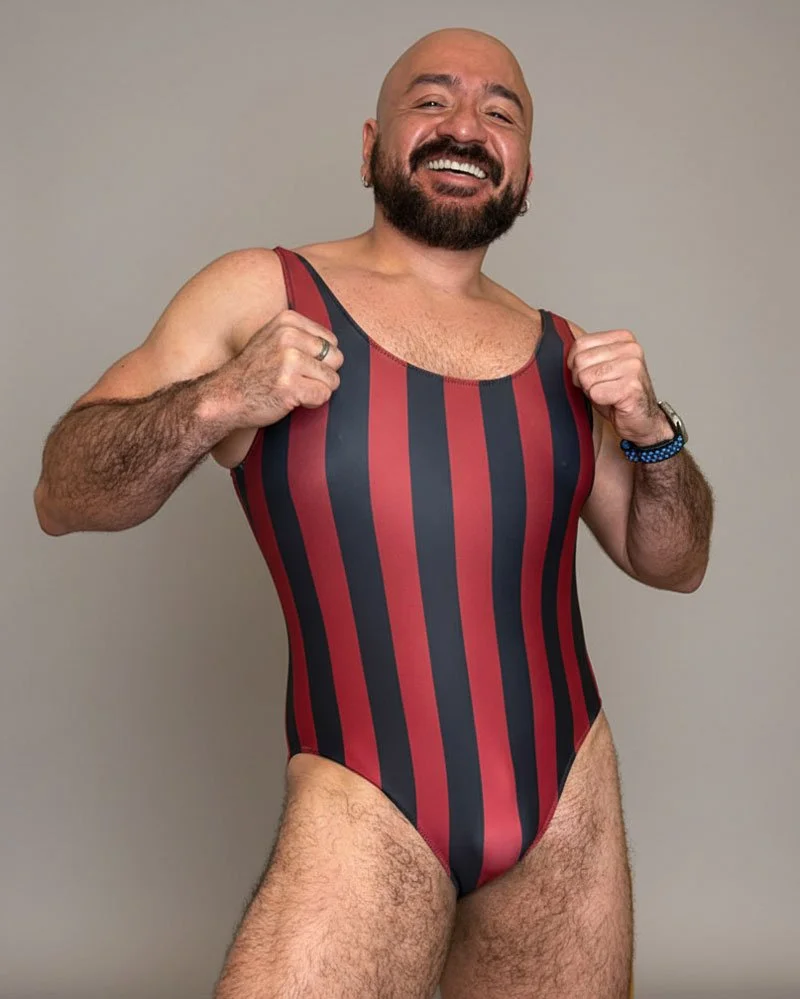
Ten years ago, I launched LED Queens Fitness Apparel as a way to create bold colorful spandex for gay and queer athletes. Over the past decade, the brand has become a destination for those of us who are on this wavelength of queer pride, spandex obsessions, bodybuilding, and also wrestling. I designed some collegiate singlets a few years ago, and they sold out immediately. As a way to respond to demand, in 2026 I launched a new line of butcher wrestling singlets that celebrates our bodies and our passions with myriad colorways that remain bold and queer. At the moment of this blog posts’ publication, we have four unique singlets available, but we will be adding plenty more to the store over the next few weeks.
For me, singlets are a cherished garment. They symbolize my playful nature when it comes to kink and gear, but they also are a reminder that we need to be proud of our bodies. One doesn’t have to look jacked or super muscular to rock a butcher. One just needs encouragement and self love. That’s why I wrote this blog post. It’s from the heart.
Beyond the Hero: Why Author Cesar Torres Is Returning to HTKS for "Roland’s Death"
After years of considering leaving the world of Roland behind, the ancestors have called me back. I am thrilled to announce a new project in the HTKS universe, code-named "Roland's Death." Moving beyond the "infantile" stakes of modern comics, this new work leverages the dark power of the Aztec ritual of Toxcatl to explore fate, queer desire, and cultural reclamation within the Aztecverse.
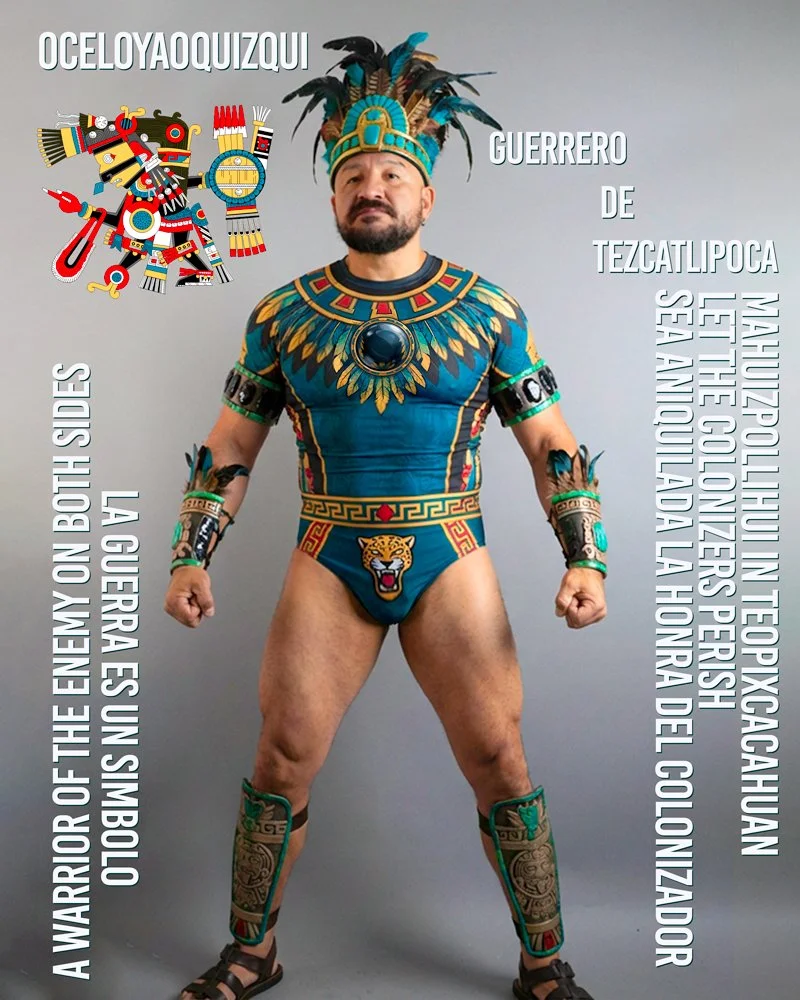
Photo Copyright Cesar Torres, 2026
For a long time, I wasn't sure if I was ready to step back into Roland’s world. In fact, for several years, I considered quitting being a novelist altogether. The journey through the first four books of How to Kill a Superhero (HTKS) was a visceral and painful experience for me as a writer. This set of four books was set to close out my lifelong obsessions with superheroes, comics and spandex obsessions. But as a Mexican artist, I’ve realized that the stories of our ancestors—specifically the complex, dark, and beautiful mythology of the Aztecs—are far from finished. Sometimes, our ancestors call us back to the place we just came from.
I am thrilled to announce a new book project, currently code-named "Roland's Death". While it isn’t a traditional direct sequel, it is a major return to the series that will finally reveal what happened to Roland after the traumatic conclusion of Book 4.
Beyond the "Infantile" Superhero: The Power of Toxcatl
In the modern landscape, superhero stories often feel trapped in a cycle of "infantile" stakes. I have been very clear about my point of view in the past 15 years: I think that superhero stories really help support the coming out process of queer folks, and they also help young people of all genders and sexual identities find their way in the world through art. But the sad truth is that almost all superhero comics infantilize the reader, simplifying stories that are far too complex to leave unattended. We can blame Marvel’s MCU to some extent, but this trend has been in place for a very long time, since the inception of comics. I am not alone in feeling this. Alan Moore wrote Watchmen for a reason, and it’s no secret that my four books of How to Kill a Superhero offered a similar point of view about superheroes and the stories we build around them. Superheroes have a limit in terms of being useful to the psyche of adults. We need deeper stories, more complex stories. Stories that don’t just entertain but that also force the reader to think critically for themselves.
To move beyond the limitations of traditional superhero stories, I leveraged the ancient Aztec Festival of Toxcatl, and I did so by a re-telling that ancient, historical ritual through the story of Roland and HTKS.
In Aztec tradition, Toxcatl was the month dedicated to Tezcatlipoca, the "Smoking Mirror"—a deity who governs duality, fate, and transformation. SPOILER: And as you know, Roland slowly begins to understand that his powers come from a powerful Aztec god. By the time we arrived at Gold, the fourth book, it’s evident that Roland has been chosen by this god. In real life, the ritual that the Mexicas practiced in the era before the invasion by the Spaniards, involved choosing a young man to live for one year as the living embodiment of the god Tezcatlipoca. He was dressed in the garb of the God, treated with the highest honor, only to eventually meet a calculated, ritualistic end. Yes, at the end of his tenure, he was sacrificed back up to the god.
When I wrote the four HTKS books, this re-telling allowed me to explore key ideas:
The Weight of Fate: Understanding that power comes with a predetermined cost. Roland has agency to some extent, but there are bigger forces moving the event of his world, and his destiny.
True Duality: Moving away from simple "good vs. evil" to the complex nature of a god who plays with the very fabric of reality. This is how I move away from the oversimplification of comics, TV and films. Most importantly, I am able to explore Roland’s sexuality through this lens too, offering up unapologetically gay and queer desire to Roland’s choices. Most mainstream franchises of heroes only offer up superheroes and villains without real sexual desires and obsessions. I wanted to give something to my readers that was honest and true to the lives of gay and queer people in leather and kink communities.
Cultural Reclamation: Using dark fantasy and sci-fi to tell authentic Mexican stories that demand to be seen and heard. I refuse to accept the meager crumbs of the colonizers in publishing circles or to compromise the Mexican aspects of my stories. It’s why I operate as an indie author and connect directly through my readers.
A New Vision: The "Warrior of Tezcatlipoca"
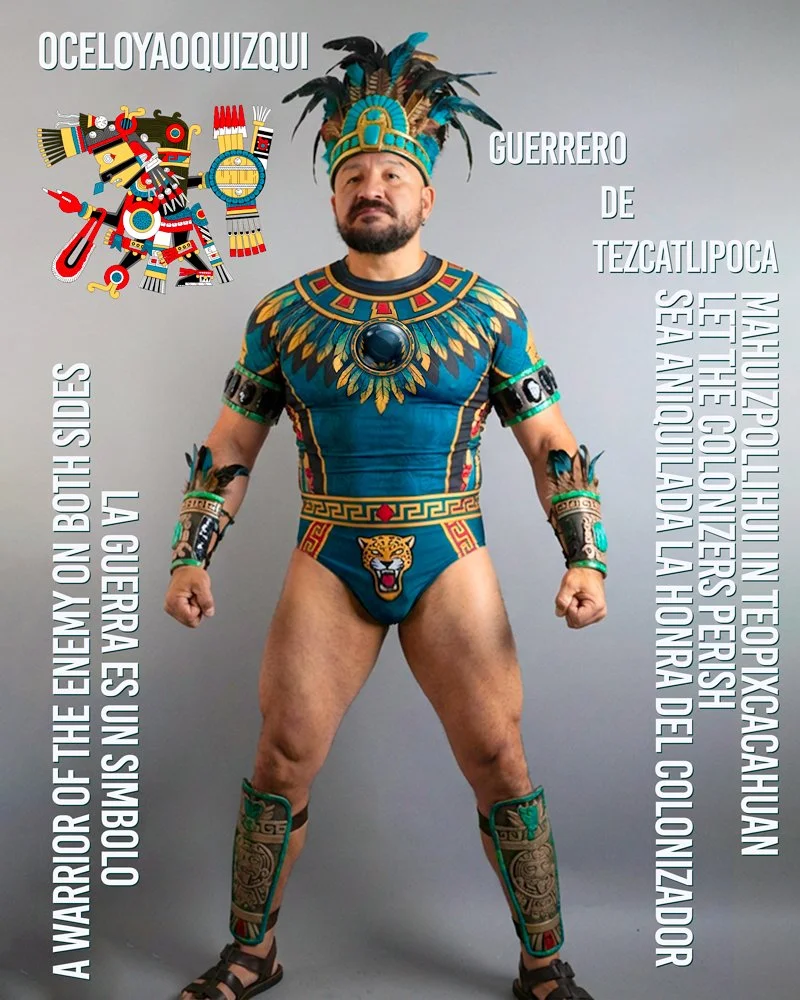
The new photo art piece I’m sharing today (seen above) represents a "Ocelayaoquizqui" the nahuatl term for Aztec warriors of Tezcatlipoca. In it, I use the canvas I love working with the most, spandex, and constellate it into a vision of text and image that expresses the way that this vision for the new book came to me. Yes, it’s a vision that I must fulfill. It captures the moment of transformation—where the ancient deity manifests through a modern vessel.
This image serves as my own call to action. It is a reminder that "War is a Symbol" (La Guerra es un Símbolo) and that the honor of the colonizer is meant to perish in the face of indigenous truth. Remember, there are wars that happen inside the psyche of every individual, and we must rise to that challenge to battle the darkest and unhealthiest parts of ourselves. And I fight this battle with my fiction and my photo and spandex art.
What’s Next for the Aztecverse?
While I work on "Roland's Death," keep an eye out for my latest book, Our Lord of the Flowers, which begins its rollout this Spring. This novel is a different beast entirely, but it is a core part of the Aztecverse.
For the eagle-eyed fans, there is a major Easter Egg and intersection between Our Lord of the Flowers and the HTKS world. Characters and threads from Roland’s journey are woven into the very heart of this new story.
If you would like to get updates on the new project “Roland’s Death” as I begin my writing process, be sure to sign up for updates in my free newsletter Muscle and Spandex.
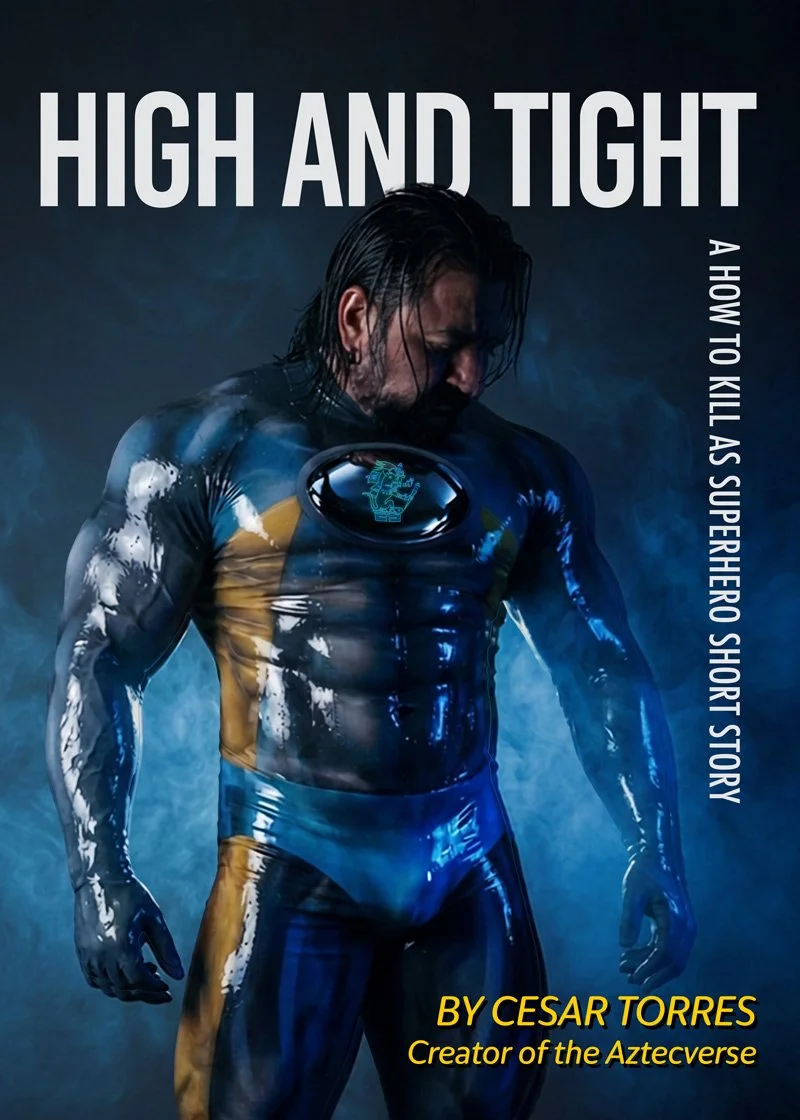
From Spandex to Digital Sculpting: How I Experiment with AI to Augment My Superhero with Soul
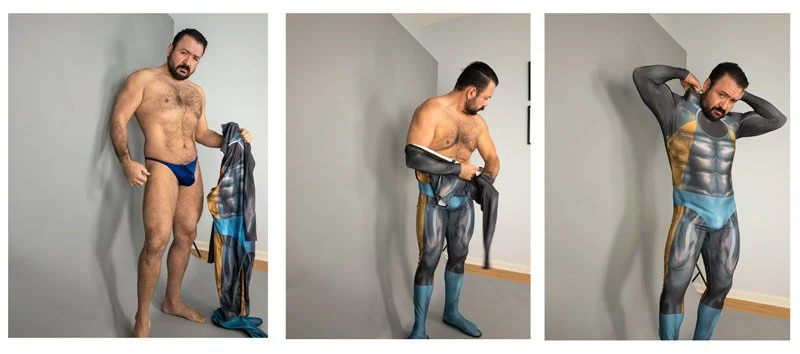
Behind the scenes photos from the 2019 Photo Shoot. Copyright Cesar Torres
I’ve been the one at the Photoshop desk since 2013. It’s always been me.
When I launched my indie inprint Solar Six and began building my Aztecverse—from The Coil dark fantasy series to How to Kill a Superhero to Our Lord of the Flowers—I didn't have a massive studio budget or a team of assistants. But I had ambition, grit, and tons of creativity. I used my background in product design, digital photography, and my willingness to spend late nights reworking every layout and retouching every image. As the founder of the queer sportswear brand LED Queens, I have never outsourced my creative director duties. To this day I still work on all the visuals for LED. And over time, my skillset as a creative director and product designer has grown. I have a vision for every book and product I launch.
I’m not a "prompt engineer" playing with new toys. I am an author and publisher who has consistently applied my own skillset in product design, graphic design, and photography. While I’ve hired human illustrators for covers when I needed skills beyond my own, the layouts, photos, and retouching that you see in my books and web sites have always been my hand.
For the record, you should also know that although I am open to exploring machine learning and AI tools for the visuals of my book universe, the actual prose and writing of my novels will always remain human centered. In other words, I write all my books completely on my own, but the book covers, marketing images and photo art will remain open to new technological advancements and approaches. Nothing can substitute my own writing when it comes to my work as a novelist.
Recently, I put out a "Call for Artists" to help create new art (book illustrations, plates, web comics) for the upcoming second edition of How to Kill a Superhero. The response? No one has reached out to me yet. To be transparent about my meager resources is not shameful; it shows I have ingenuity. Even if I believe AI products are inherently colonizer tools, I’ve written about how brands can pivot or leave them behind. But right now, I refuse to let Roland’s story stagnate.
High and Tight: Evolution
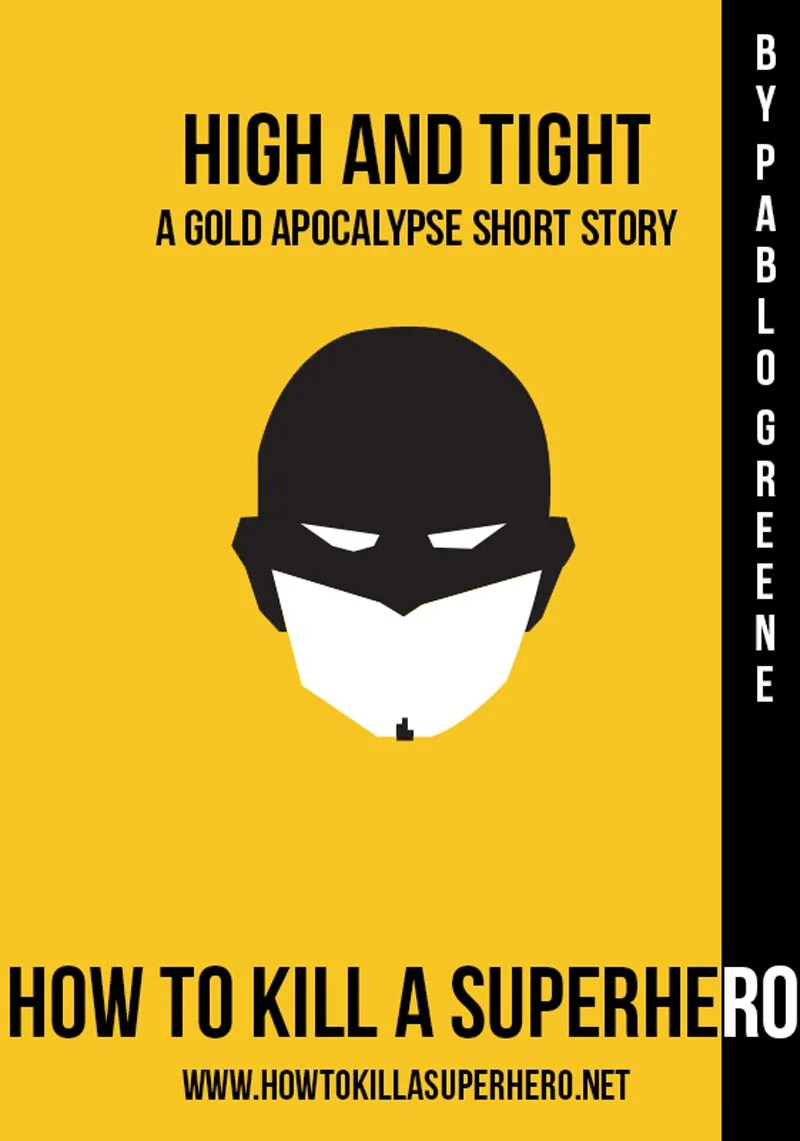
High and Tight is a free short story that I launched on Kindle several years ago as a way to give readers a freebie that pulls them into the book series. But it’s also an essential story about Roland that takes place between books 1 and 2 in Berlin, Germany. Above you can see the original cover that I launched. In 2026, I am preparing to re-design the cover and elevate it to a whole new level. In this new cover I plan to show Roland as a human figure instead of an emoji-like icon. So let me walk you through a major creative (and technological) evolution, and the part you have to play in this story.
The Model and the Canvas: The Alex Ross Precedent
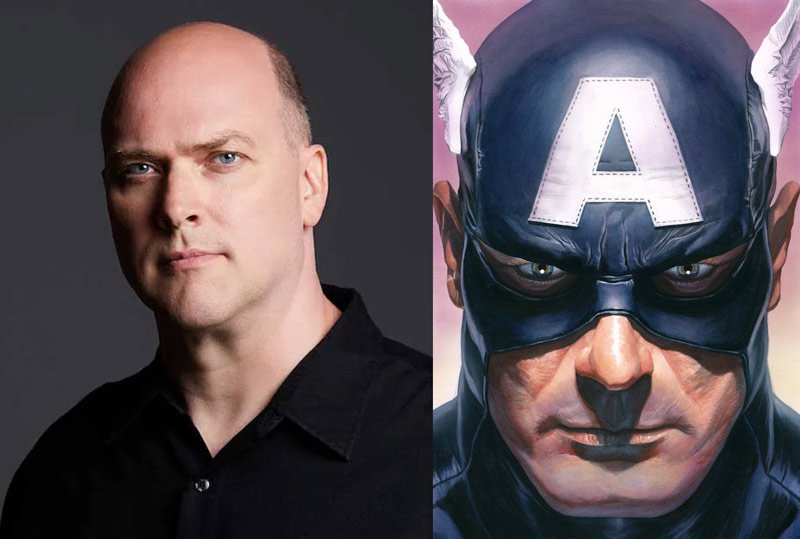
Images via https://www.alexrossart.com/
I am proud to use my own body as the model and the canvas of my own books. I did this for almost a decade as Pablo Greene, and I am doing it even today as myself in my adjacent project Our Lord of the Flowers. Using myself as a model is born of the same necessity that fueled legends like Alex Ross. But it’s also something deeper for me, closer to the work of Cindy Sherman and Frida Kahlo, as a way to explore interiority and reality. I don’t know exactly why Alex Ross uses himself as a model for some of his paintings, but I can assure you there’s creativity at the heart of his impulse, too.
Alex Ross has gone on record to say he had many superhero suits sewn in spandex, using a self-timer and a camera to create models of himself that he could paint later. He claims he has burned those photos since, but he’s on record discussing this: Alex Ross on using himself as a model. I am following that same lineage—using my own body to ground the character in reality.
The Evolution: A Technical Walkthrough of the Four Stages
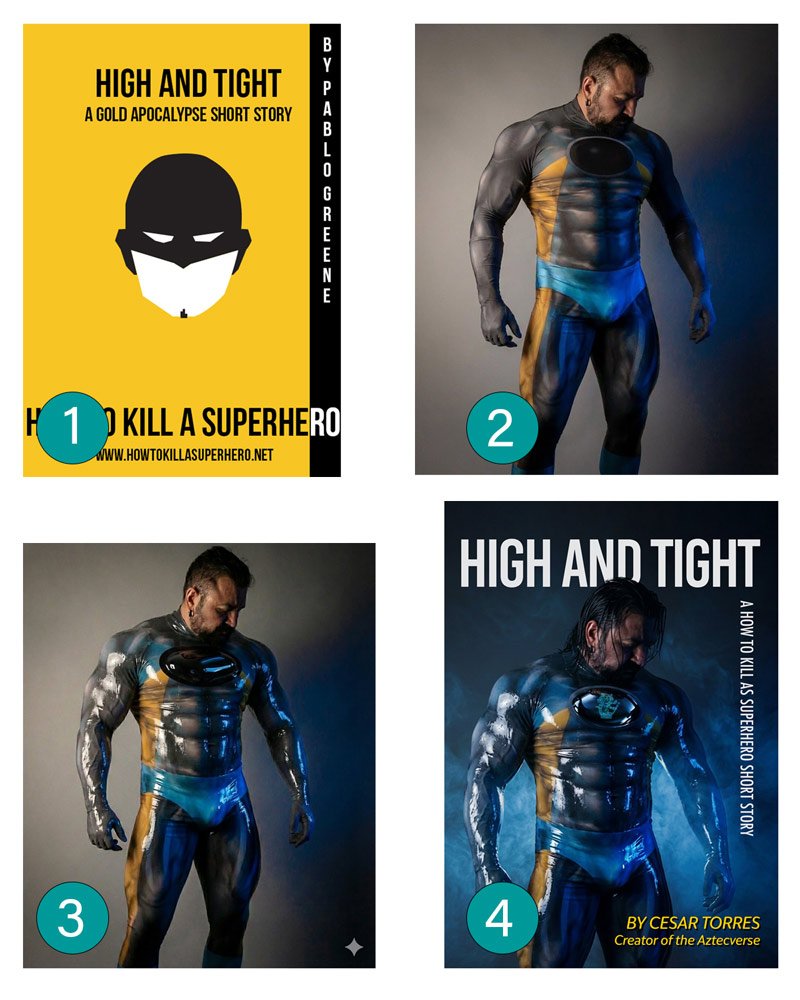
This design refresh is part of my process as an artist and designer. It’s a way to open up creative opportunities for the upcoming second edition of the series. Here is exactly how I navigated the four stages of this project:
Stage 1: The Original Yellow Cover This was the starting point, designed by me. It utilized the center icon designed by illustrator Nick Agin. It was a clean, graphic approach, but as the HTKS universe has evolved, the cover needed to move toward something more visceral and cinematic.
Stage 2: The 2019 Studio Shot The foundation of this new direction is a photo studio shot I took in Chicago in 2019. I am wearing the real Roland cosplay spandex bodysuit I had custom-made. Mark Dupuis (4neodesigns) created the dye-sub pattern, I had the suit manufactured in China, and I shot the photography myself in my Chicago photo studio, using my Sony A6400 camera. This suit was a staple for my YouTube channel, marketing materials, and socials. This is the human "soul" of the image, and an extension of the book cover for Gold, the fourth book in the series
Stage 3: The Digital Sculpting (Nano Banana) To move from spandex to a "superhero" texture, I applied "wet look" and mirror effects to the chest of the figure. I used Nano Banana (by Google) to achieve this. Using AI here saved me the immense effort of doing this manually in Photoshop with complex filters and brushes—a task that would have taken me hours of meticulous retouching.
Stage 4: The Final Composite and Narrative Detail The final image includes long, wet hair—a defining trait for Roland. Generating wet hair digitally is an extremely difficult and expensive task in editorial photography. Nano Banana helped generate the hair, but the final image is a result of my professional skill set. I manually masked out the figure, swapped the background, included fog and smoke, and handled the typographical design.
This is a reflection of my skills in product design and decades of photography experience. I have the chops for this, and I’m using these tools to bridge the gap between a $0 budget and the cinematic quality my readers deserve. Keep in mind that this work in progress has not yet been launched as a new cover for the short story. It’s still in development, which is why I am writing this post.
The Challenge: I Want Your Feedback
So now that you can see how I work, it’s important for me to listen to your feedback about these approaches. In indie publishing spaces, the use of AI remains controversial, but pivotal. For some book authors and their indie imprints, tools like Nano Banana may allow them to scale better. For some, it won’t. But I feel that it’s important for me to communicate to you that since the very first book I ever launched as an indie author back in 2013, I have been the visionary that has driven the covers and branding forward, choosing fonts, making photo shoots happen, selecting palettes and visual languages, tackling UX. And as I look ahead at the rest of 2026, I want to continue to experiment with new tools, but I will do so with my own ethical and creative frameworks in mind. You may challenge me and demand that I go hire a full team, but keep in mind that for indie authors like me, the resources to do so are meager. And that leaves me with my most powerful tool: my imagination. My imagination is big, and it creates full worlds. I hope that this narrative can help you understand where I am coming from, and where I plan to go, together with you, reader.
I think of AI tools as helpful, and I believe they should be used lightly. I am moving toward a hybrid approach to make sure my work evolves, but I won’t do it in a vacuum. I want to provoke a conversation:
Do you think the way I used AI in this potential new cover is ethical? Or is the use of these tools such a turn-off that you would never download the product, even if the "bones" of the image are 100% my own body and photography?
The Human Gap: If you are completely against AI, why isn't anyone writing me back for the call for human artists? I cannot afford a $5,000 physical photo shoot to reproduce this revision. How do we keep indie publishing alive if we don't use the tools at our disposal?
I love Roland and the HTKS books with a passion. I want these tools to help me tell the story properly—with scale, but with soul.
What is your actual point of view on this? I’m listening. Send me your feedback.
The Shadow and the Mirror: Why Tezcatlipoca is the Heart of the Aztecverse
Explore the intersection of Aztec mythology and queer leather culture in Cesar Torres' HTKS series. Discover why Tezcatlipoca, the Lord of the Smoking Mirror, is the structural backbone of Roland’s world and the modern Toxcatl ritual.
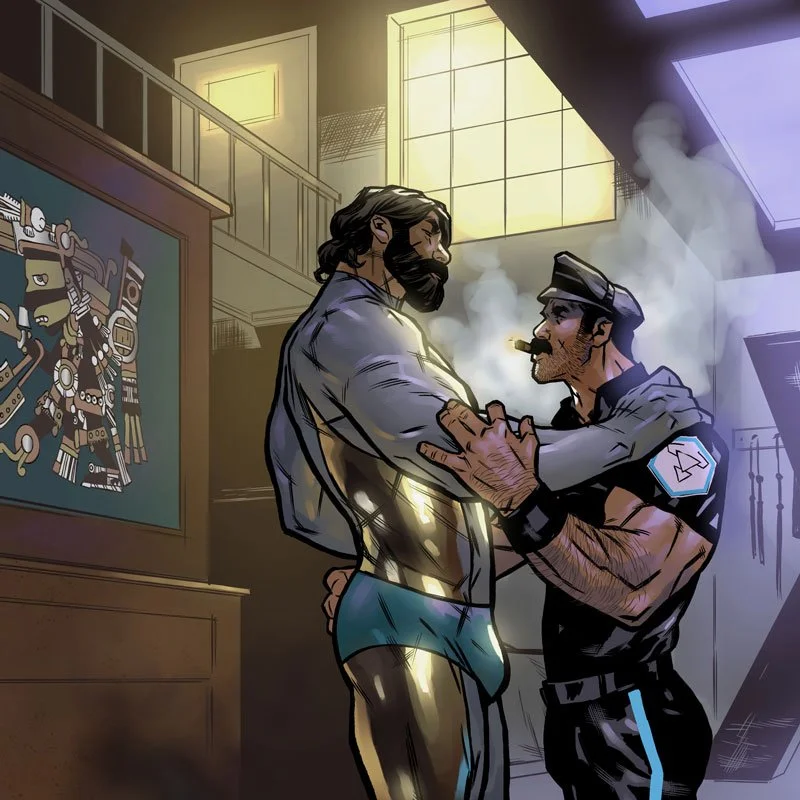
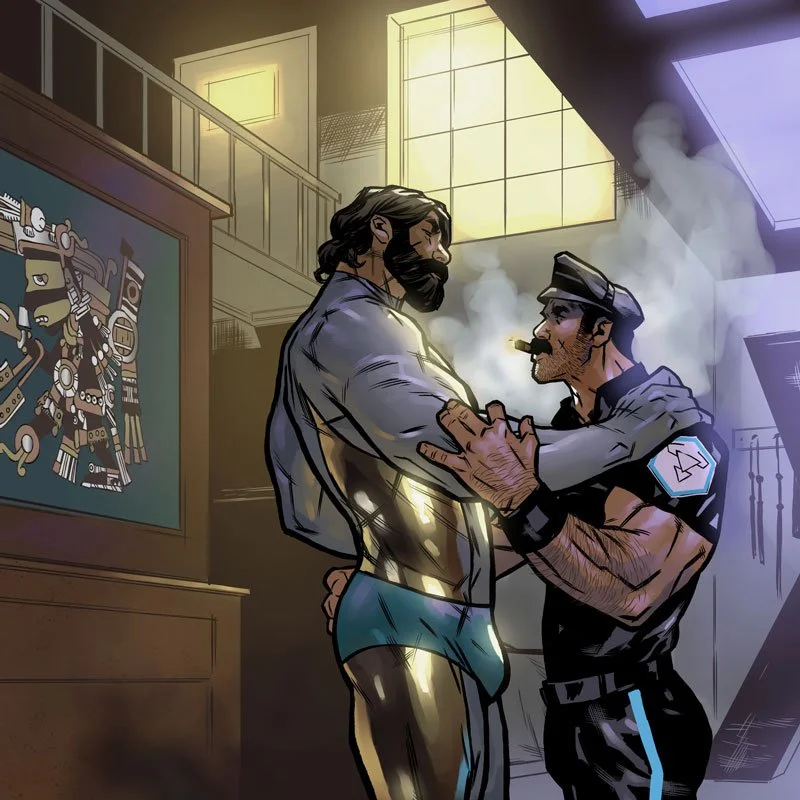
Illustration by Adam Graphite.
Power (and Darkness) in the Mirror
In the world of Indigenous Futurism, many stories rely on the image of the Mesoamerican pyramid. But in the How to Kill a Superhero (HTKS) mythos, the Aztec gods aren't buried inside a pyramid or templte. They are living, breathing, and often terrifying forces of the future, embedded into second skins of spandex, rubber and leather.
To understand Roland, you must understand Tezcatlipoca, the Lord of the Smoking Mirror.
Who is Tezcatlipoca?
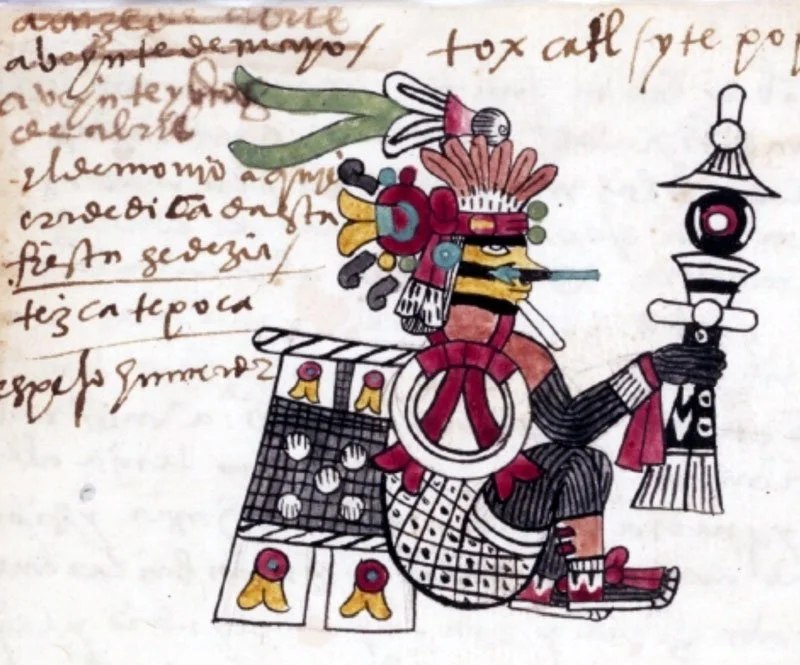
Representation of Tezcatlipoca in Codex Tudela, where the ezpitzal is shown as a headband and garland
In Mexica (Aztec) philosophy, Tezcatlipoca is the god of the night sky, the protector of the marginalized, and the bringer of both fortune and disaster. Unlike Western "moral" deities, he is a tester of souls. He carries an obsidian mirror that reflects the secret thoughts and hidden truths of humanity. He is a trickster god, but also a god that was deeply venerated by the Mexicas. He was held in high regard, and when unfortunate events happened to people, it was his symbolic meaning that helped communities reconcile, cope and even transform the meaning of tragedies, cruelties, or bad luck. He is also the god of nagualismo, because he holds the power to transform at will. Most often he transforms into jaguar, but he was also known to transform into a wild turkey. But his power of transformation was vast; he changes into many shapes in myths.
For the smart reader, the connections are woven into the text and art. Tezcatlipoca is the "Structural Backbone" of Roland's world—the provider of his powers and the architect of his fate.
WARNING: SPOILERS AHEAD
The Queer "Second Skin"
There is a reason Cesar Torres’ HTKS series resonates so deeply with queer and leather subcultures. In these communities, gear—leather, spandex, rubber—isn't just a costume; it is a ritual transformation.
Tezcatlipoca is the master of Transgression. He exists in the "in-between" spaces. He is a lord of the liminal. For Roland, putting on the suit isn't about becoming a "good guy"; it’s about accessing a power that is ancient, powerful, and inherently fluid. And we must stress the word fluid. Rolan'd’s suit can change color, shape and texture, based on his will. At times it feels and looks like a membrane, and at others, it becomes the resplendent nylon spandex of Roland’s fantasies, which are derived from his obsession with superheroes in the comics. But his suit is inherently magical, a type of gift that he has been given by the Smoking Mirror. In the above dungeon scenes with Nathan, notice the art on the walls—Tezcatlipoca is there. This illustration was created in the late 2010s by Adam Graphite, in collaboration with myself as a way to bring Tezcatlipoca’s influence to life through illustration. I specifically asked Adam to include the image of Tezcatlipoca show up in the composition. Here, we see the true effect of this ancient Aztec god: He is the Lord of the Night Wind, overseeing the ritual of power exchange and the revealing of the shadow-self. He provides a type of blessing to Roland in his myriad leather and kink sexual encounters with gay and queer men in the series.
A Vision of Spandex, Mexican Skin and the Power of the Mirror
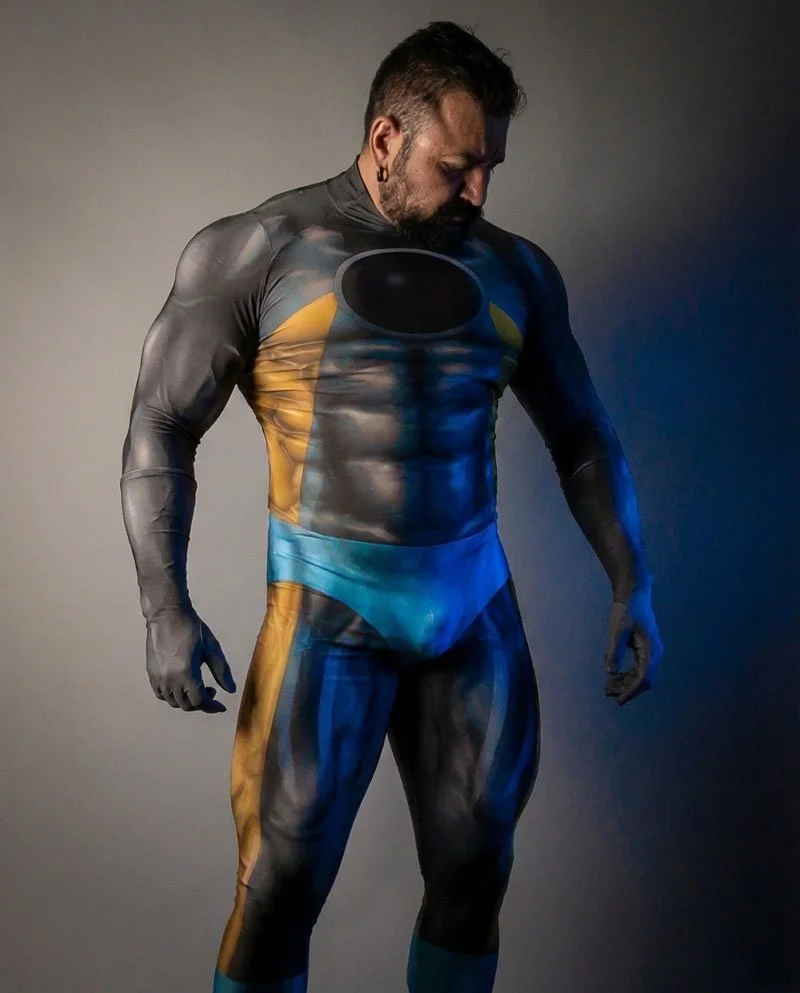
Photo by Cesar Torres, Copyright Cesar Torres
It’s important to share with you this archival photo from 2018, when I cosplayed as Roland as a way to embody themes and symbols of the HTKS book series. This suit is very special, because it matches the way that the suit is rendered by Adam Graphite on the cover of Gold. I had this suit custom made in spandex for me, in order to create new photos in my photo studio in Chicago. I share it with you to explain the concept of embodied text: as a book author and writer, I embody my books with everything I do, say and wear. And in this case, I entered my own Toxcatl festival by donning the skin of Tezcatlipoca/Roland. As you know, I have since retired from cosplay modeling and moved onto a new text embodiment by wearing the skin of another Aztec god, Xochipilli. That project is called Our Lord of the Flowers, and you can see my latest works over in the book’s photo galleries. In this sense, you can say that yet another Aztec deity has taken me over, but we can never forget that the first one to do so was Tezcatlipoca.
By retiring from the era of superhero cosplays, I in essence was sacrificed up to Tezcatlipoca in an act of Toxcatl ritual, which I will cover below.
A Modern Toxcatl
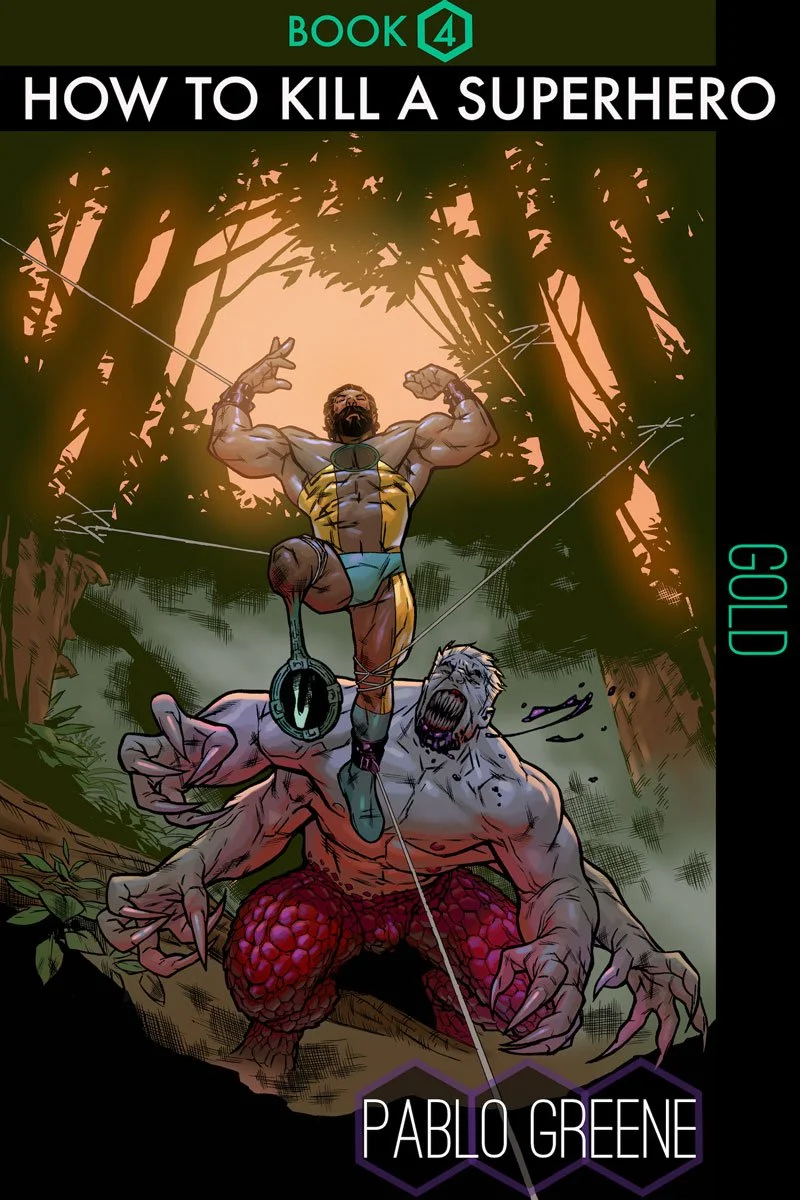
Cover of Gold, Book 4 of How to Kill a Superhero
The four HTKS books explore the Toxcatl ritual. In history, a beautiful youth was chosen to live as the personification of Tezcatlipoca—treated as a god for a year before the ultimate sacrifice. Roland is our modern Ixiptla (deity impersonator). He wears the spandex and the muscle not as a hero's uniform, but as a ritual garment for a cycle of sacrifice and rebirth that mirrors the mythic battle against the primordial monster, Cipactli. And as we close out the book series in the fourth volume Gold, we come to understand that Roland will not live forever, and the suit won’t save him. In keeping with the tradition of Toxcatl, he will be sacrificed and his heart ripped out to close out his tenure in the Toxcatl ritual, making way for another Ixiptla to step in.
Beyond Visual Nostalgia
Every book I have ever published in the Aztecverse is deeply woven by the Aztec gods and goddesses, and yet, you won’t find typical imagery like pyramids or codex art on my book covers. I avoid pyramids on my covers because the gods of the Aztecverse are active today. Their "portals" aren't stone arches; they are inner experiences, acts of indigenous insight, as well as acts of bravery against colonialism and fascism. In other words, I am always invoking Aztec thought and imagery, but through allegory and symbol. And what’s most important to remember is that there are many secret symbols in every visual and textual manifestation of my books, ranging from the covers, to my art phootography, to my Instagram captions, my Muscle and Spandex newsletter, as well as interviews I give to bloggers and journalists. The Aztecverse is in everything I make, if you know how to see it.
Explore the Lore
To dive deeper into the hierarchy of the gods and how they influence the HTKS universe, visit the official Tezcatlipoca Pantheon Page.
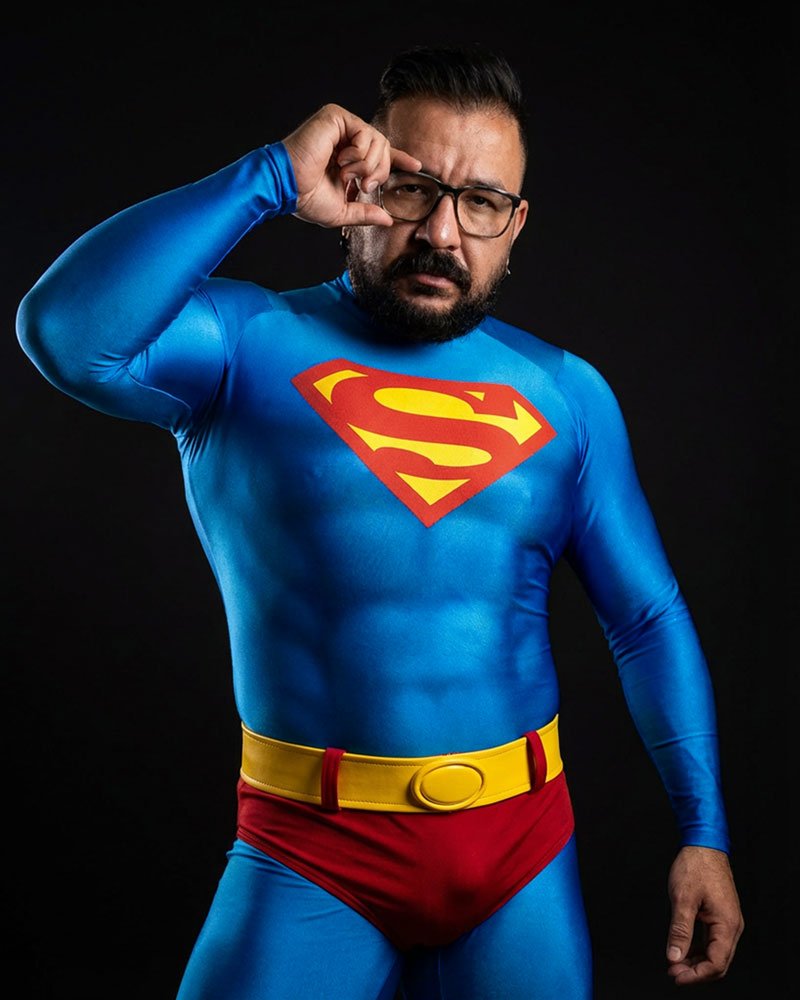
Why Superman is One of the Top Gay, Queer and Kink Icons
From the "closet allegory" of Clark Kent to the hyper-masculine "physique culture" of his origins, discover why Superman remains a radical symbol of queer resilience and fetish culture.
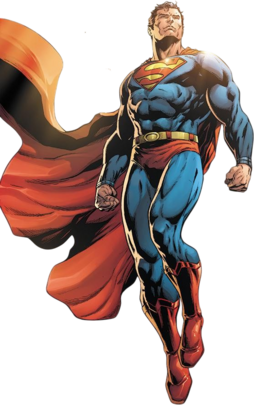
By now, so much has been said about Superman and his legacy in 20th and 21st-century culture, but I will go ahead and say the obvious anyway: Superman is a gay and queer icon.
We all know it's true. And by "we," I mean the culture at large—not just queer people.
And yet, many people refute this phenomenon. The people who panic and become enraged when we talk about the queer resonance of the character created in Action Comics by Jerry Siegel and Joe Shuster are folks who seek to erase the existence of queer people and the way they contribute to culture as a whole. That makes those haters homophobes and transphobes.
If you gatekeep superheroes in order to protect your heteronormativity and close-mindedness, good luck, because you have never had any control over them. And you never will. Superman is a piece of art, and art's subjectivity means you can't touch the way it resonates or connects for other people.
A Massive Impact on Queer Culture
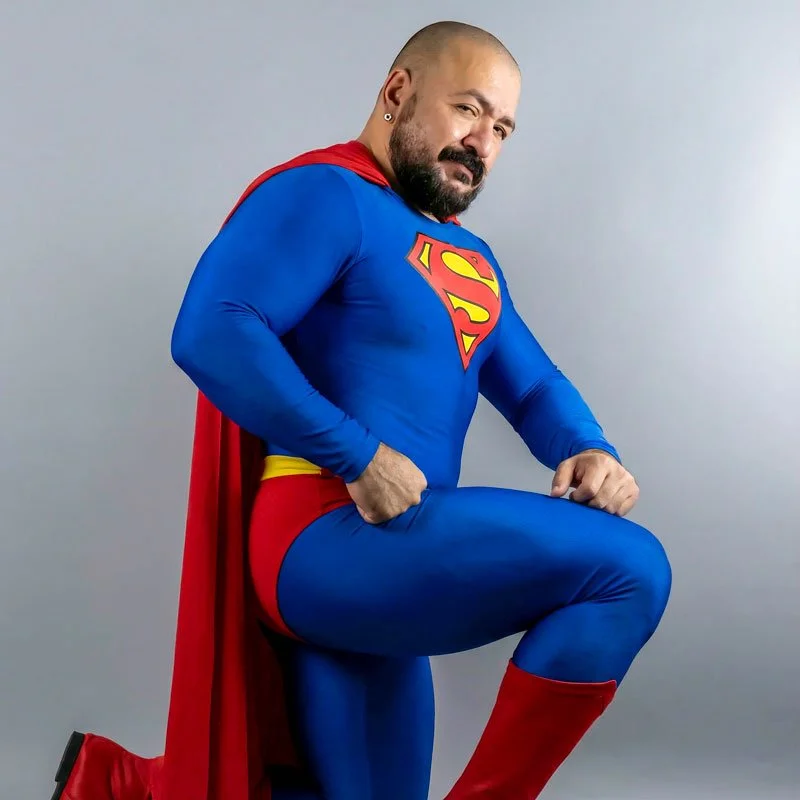
Photo Copyright Cesar Torres
Superman’s impact on queer culture is rooted in a very obvious "closet allegory," where his double life and secret identity mirror the lived experience of "passing" and the performance of heteronormativity. This subtext is reinforced by creators Jerry Siegel and Joe Shuster's own status as marginalized outsiders. As the children of Jewish immigrants, Siegel and Shuster channeled their experiences of social alienation into a character who must navigate a world that doesn’t fully understand his true nature.
Furthermore, Shuster’s specific artistic sensibilities—heavily influenced by the "physique culture" and bodybuilding magazines of the 1930s, as well as his later anonymous work for the fetish publication Nights of Horror—infused the character with a hyper-masculine, "camp" aesthetic that serves as a site of both aspirational power and queer desire. Ultimately, this intersection of a "hidden" self and a theatrical, skin-tight costume has allowed the character to transcend his straight origins, evolving into a symbol of queer resilience that emphasizes the performance of identity and the rejection of domestic conformity in favor of a radical, alternative existence.
Detailed analysis of these cultural parallels can be found in Eric Berlatsky’s study on homosociality and triangular desire and J. Drew Stephen’s exploration of camp aesthetics in the Man of Steel’s cinematic history.
A Brief Word About the Costume
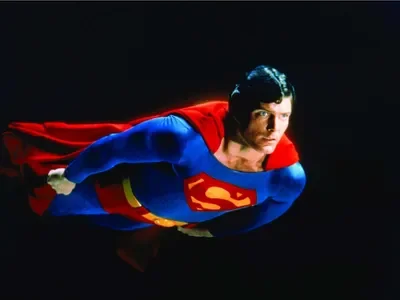
Christopher Reeve’s in the film adaptation of the comic
There is also an inherent gay and queer sensibility in the costume of Superman. It's bold, colorful, and skintight—not afraid to celebrate his massive chest, thick legs, muscular glutes, or any part of his body. His costume is as free of shame as his nakedness would be. Since the character's creation, the costume has been drawn in such a way that today we associate spandex with images of Superman. Most intellectuals won't name it, but I will: there is an erotic allure to his costume. It's no surprise his leotard and red trunks show up so often in the erotic imaginations of all kinds of people, including myself.
I have donned the Superman costume many times. You can see it in my Cosplay Archives, but also in my digital photo set, Ice and Leather.
Superman Resonates Loudly in Kink Spaces
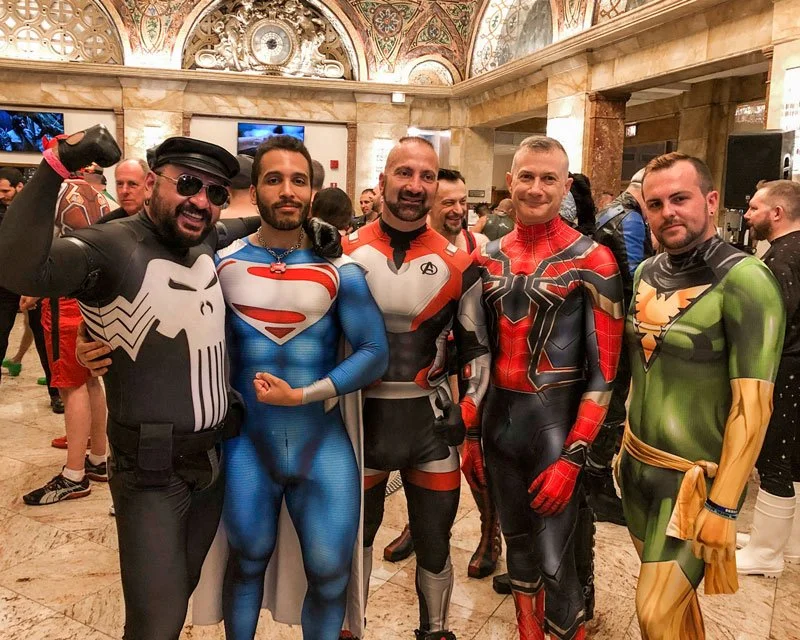
Superhero Fetish Meetup at International Mister Leather 2019, Photo by Cesar Torres
If I were to name one fictional character that shows up the most in queer kink and leather culture (as well as cis/het kink culture), it would have to be Superman. We now live in an age of amateur porn, OnlyFans, and JustForFans, and it's easy to see the emblematic blue leotard, red trunks, yellow belt, and stunning red cape show up over and over in erotic scenes. People from all walks of life stage these as a way to embody power exchange, using the very stories of the character. In many of these videos, short films, erotic drawings, and AI-generated art, fans show Superman being subdued by kryptonite, Lex Luthor, or other villains, mirroring the beats of the comics, TV series, and films.
I have been a member and leader in leather and kink spaces for twenty years, and it delights me to see Superman motifs and costumes show up at places like MIR, IML, Darklands, and many more.
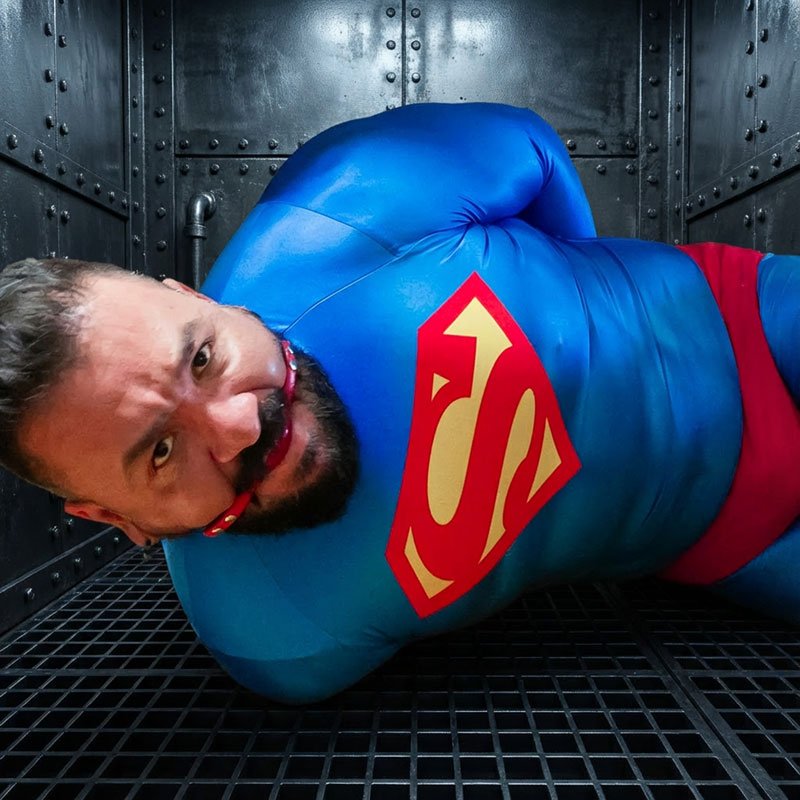
Photo Copyright Cesar Torres
Most journalists, writers, and academics are much too afraid to name this phenomenon of fans eroticizing Kal-El. That's were I come in. I write, live, and breathe superhero fetish. I can not only name my own fetish for Superman, I can describe for you how he tends to turn on so many queer folks I have met over the years. It will come as no surprise that whenever I have posted photo sets of myself in a Superman costume, I receive DMs and private requests for more—specifically, photos where Superman is bound, gagged, and punished. That's because the Superman character activates archetypes within ourselves that cannot be silenced.
What Superman Did for My Own Queerness
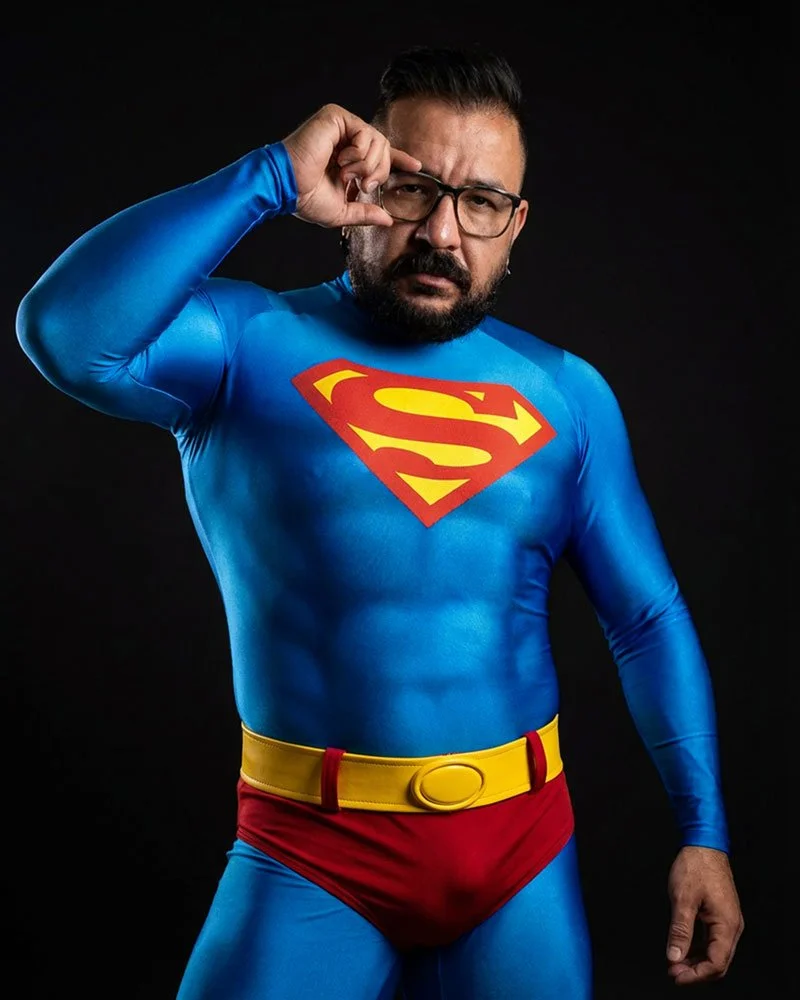
There is nothing wrong with erotic fantasies about Kal-El. Superman after all, helped me investigate my own queer and gender identity a long time ago. He helped me understand the dynamics of living in the closet, and in that sense, I parted ways with him many years ago—first when I came out as gay at 21, and again when I came out as non-binary in my late forties. Yes, Clark Kent still lives in a type of closet, but I don't. Today, I feel much closer to a Magneto, who emphatically does not have a secret alter ego. In terms of a superhero who aligns with my gender experience, I feel much more aligned with Mystique than the limiting confines of masculinity that Superman exists in.
And yet, I have much love for Superman, whose muscular and ethical beauty still dazzles my imagination.
Do I still play with Superman when I engage with other kinksters? You bet. That's the beauty of art, story, and roleplay. We can revisit characters, deconstruct them, destroy them, and even rebuild them as part of play.
Superman Keeps It Queer
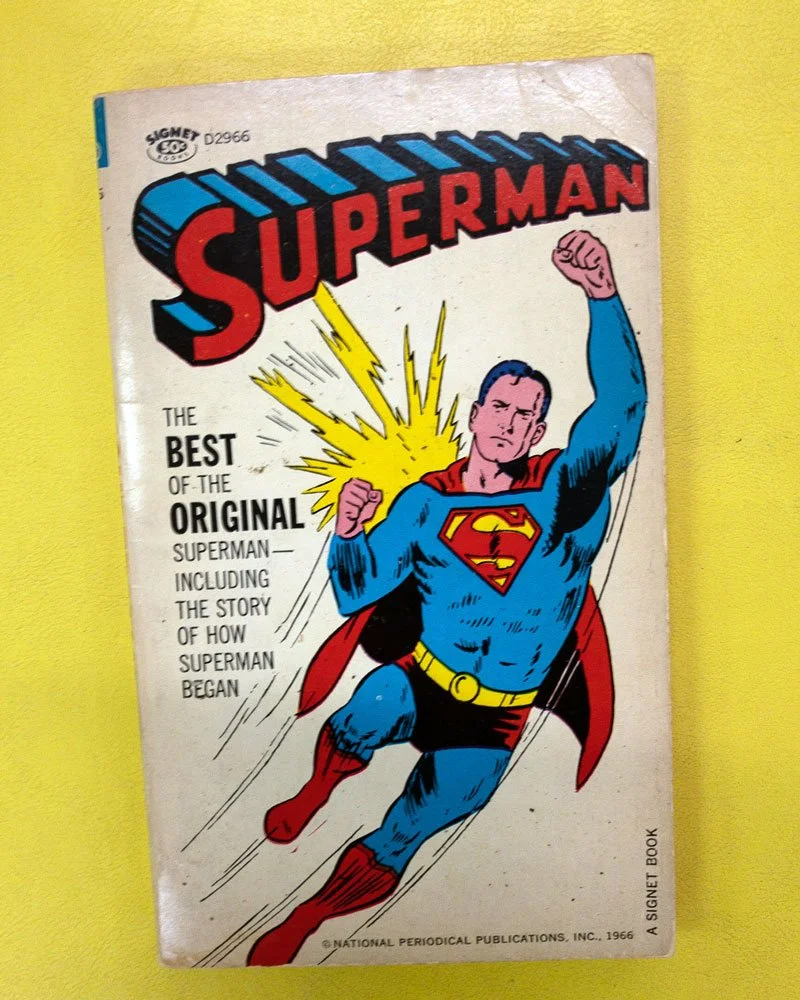
The reason I wanted to publish this essay is that what I do here at HTKS—as the creator of a unique set of novels for queer people who want superhero stories—is rooted in love and support for my community. I love the kink and leather communities, where Superman is still emblazoned on many people's presentations as a way to be fiercely queer. There's truth and beauty in that. It is important to remind ourselves that Superman also belongs to us. No matter how much homophobes and transphobes may hate us, we know something special about Superman and Clark Kent. Nothing can change his status as a gay and queer icon.
The World Without Daylight Spandex Suit: A Superhero Cosplay Memory
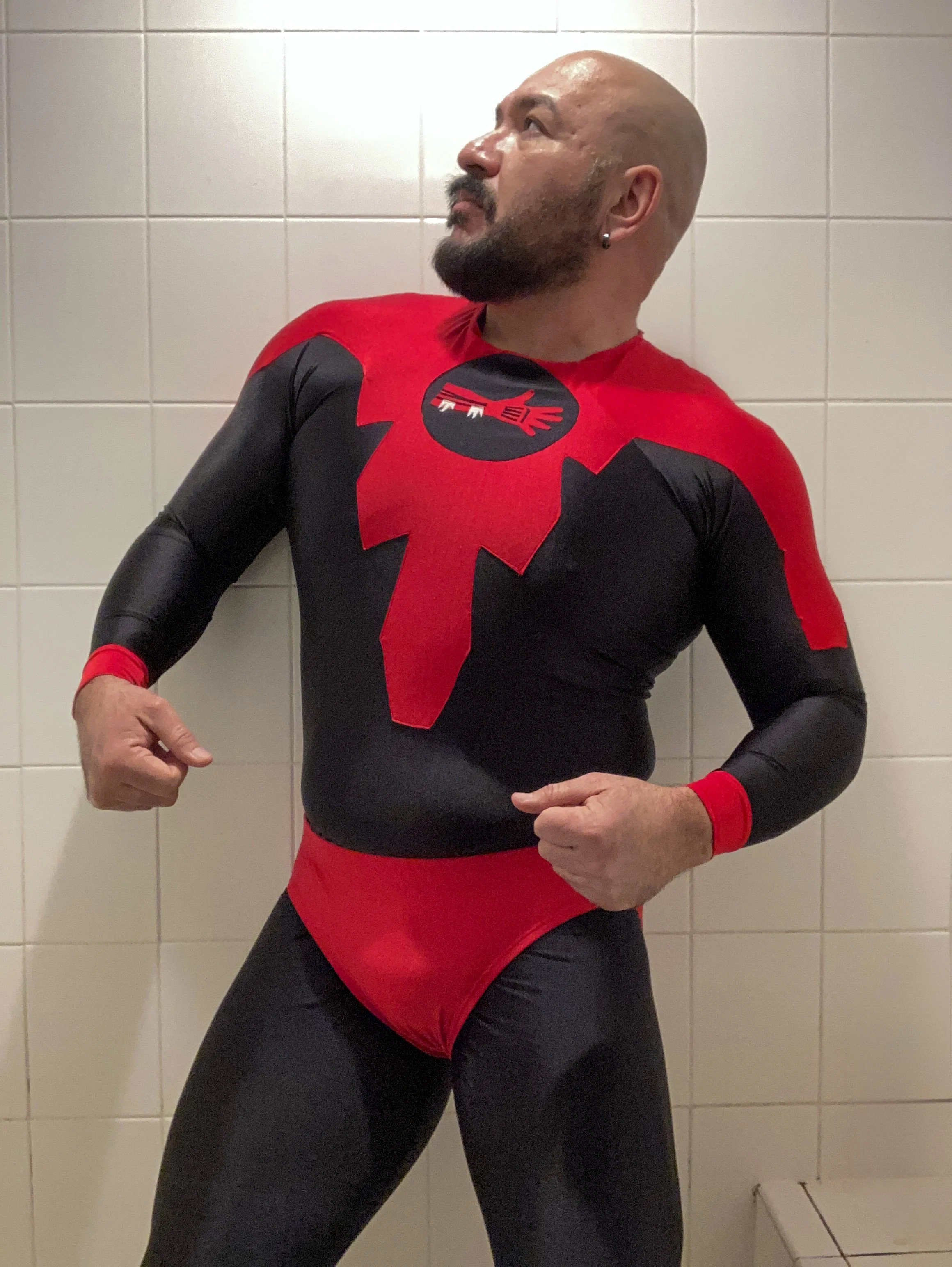
In 2014, while launching World Without Daylight, I collaborated with a fellow creator to design a spandex superhero suit that embodied the book’s themes through color, shape, and texture. Looking back now, the suit—and the original cover it echoed—feels like a vault artifact from an era defined by creative intensity, collaboration, and transformation.
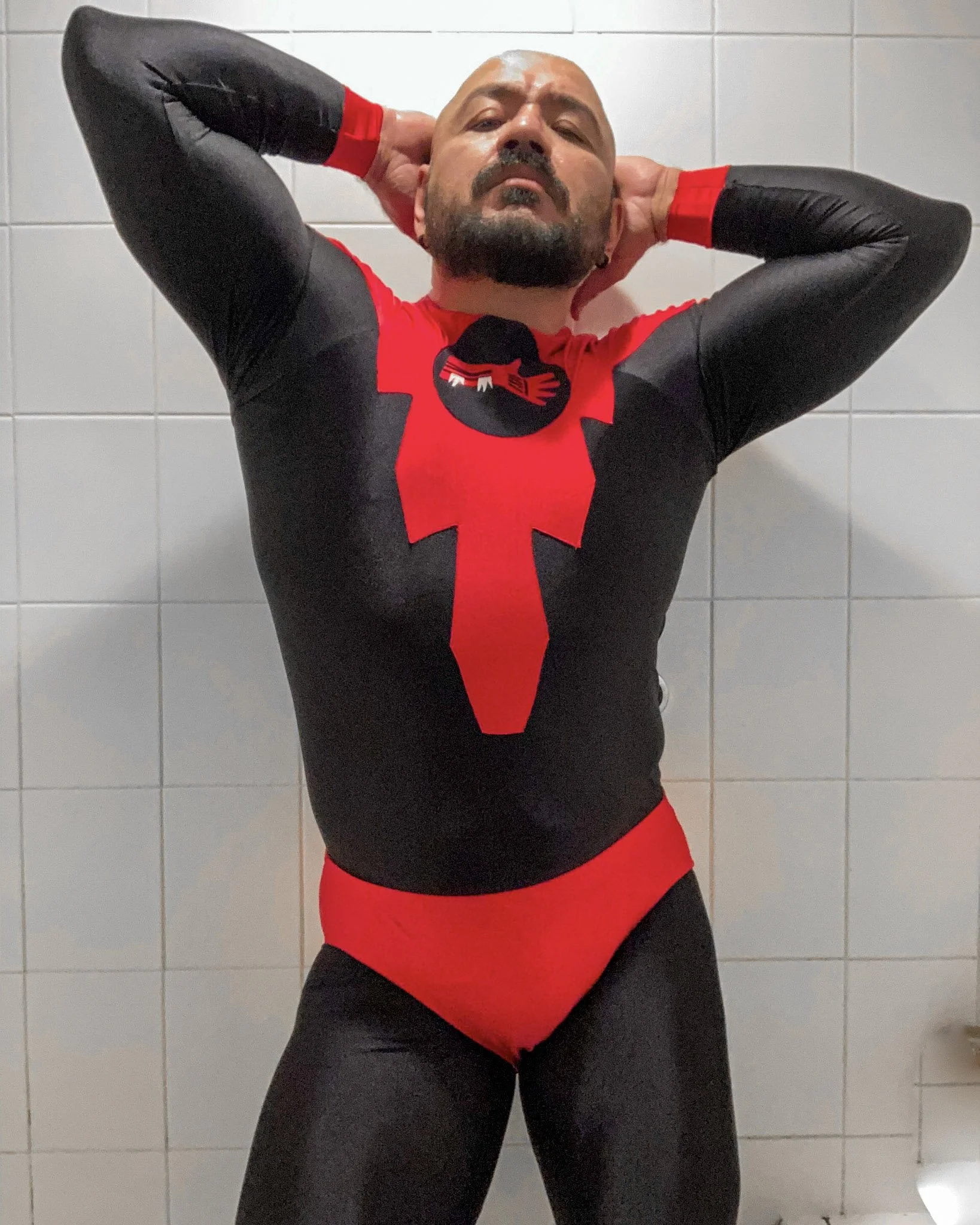
Photo Copyright Cesar Torres
Back in 2014 when I launched World Without Daylight, the second book in the How to Kill a Superhero tetralogy, I wanted to represent the book through shape, color and fabric. I wanted a superhero suit that embodied the book.
I was lucky enough to know Shane Sprankel, a member of the kink community who loved my book series, and who also loved spandex superhero suits. Shane had already designed and tailored a suit for the first book in the series, and when I asked if he could work on the sequel, he said yes.
About the Cover
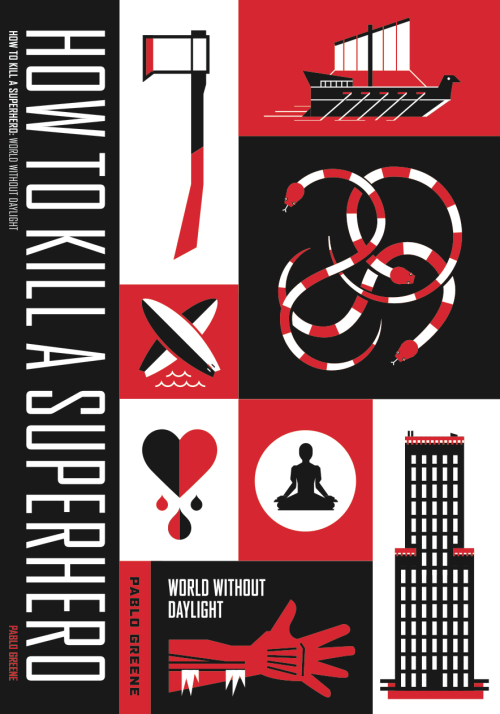
This is the original cover of World Without Daylight, the second book in the HTKS series. Designed by Nick Agin.
This red, white and black cover is actually the original cover of the paperback. However, I soon replaced it with the version you see today on Amazon and on my web stores. Nick Agin, a designer I met in New York City, designed this stunning cover that was inspired by thrillers from the 1960’s and their colorful graphic design. However, once I started working on Transformation Fetish, the third volume, our mutual schedules and needs prevented us from him designing all four covers. So what you see in today’s superhero confession is a bit of a vault item for the fans of the series who were there in the early years.
The Suit
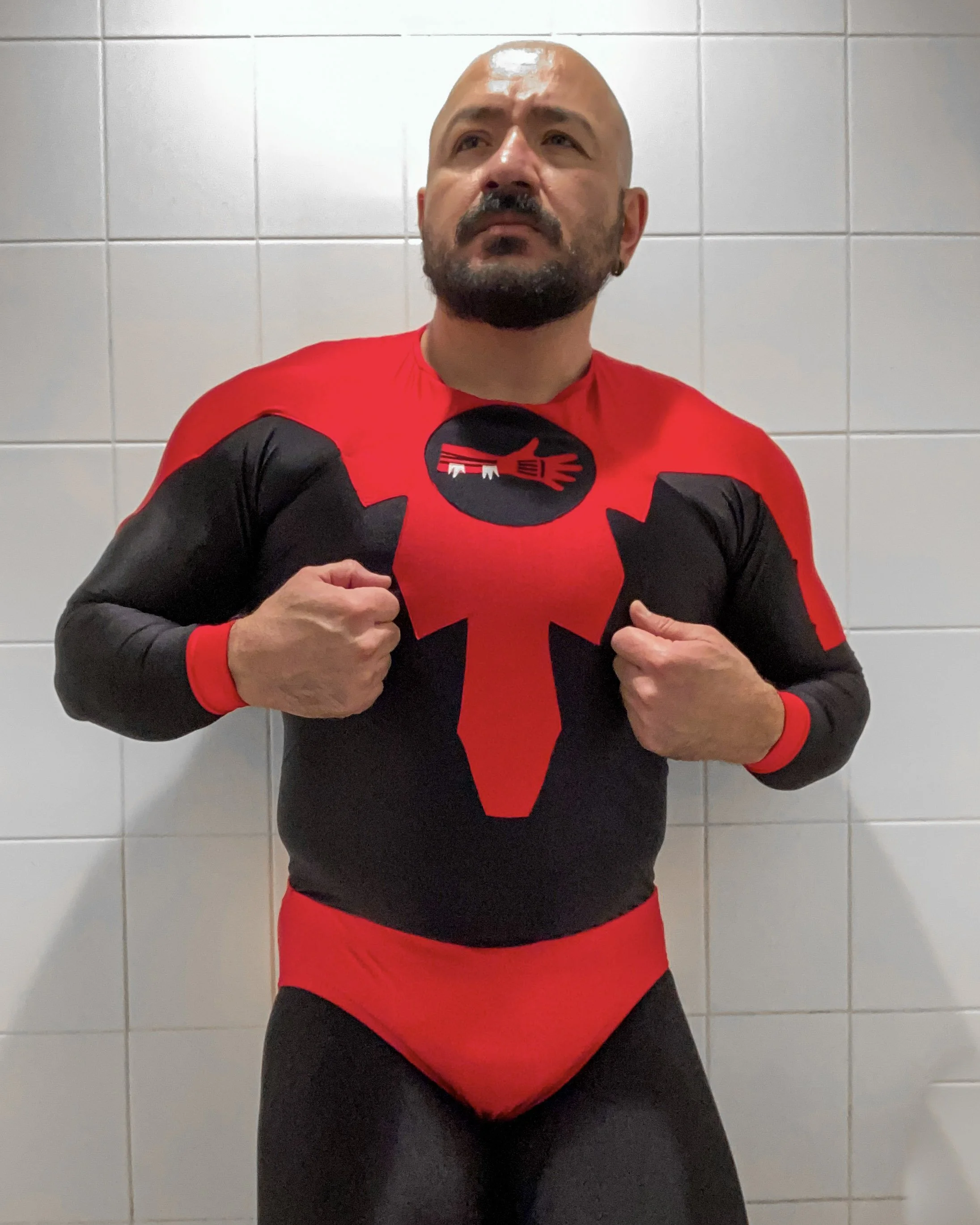
Photo Copyright Cesar Torres
I wore this suit to Comic Con, several events in NYC and a few leather contests. I loved the pop-art stylings of the suit, and since I am partial to the superhero trunks as part of a look, it delighted me to wear the red spandex over the black leotard.
How I Feel Now
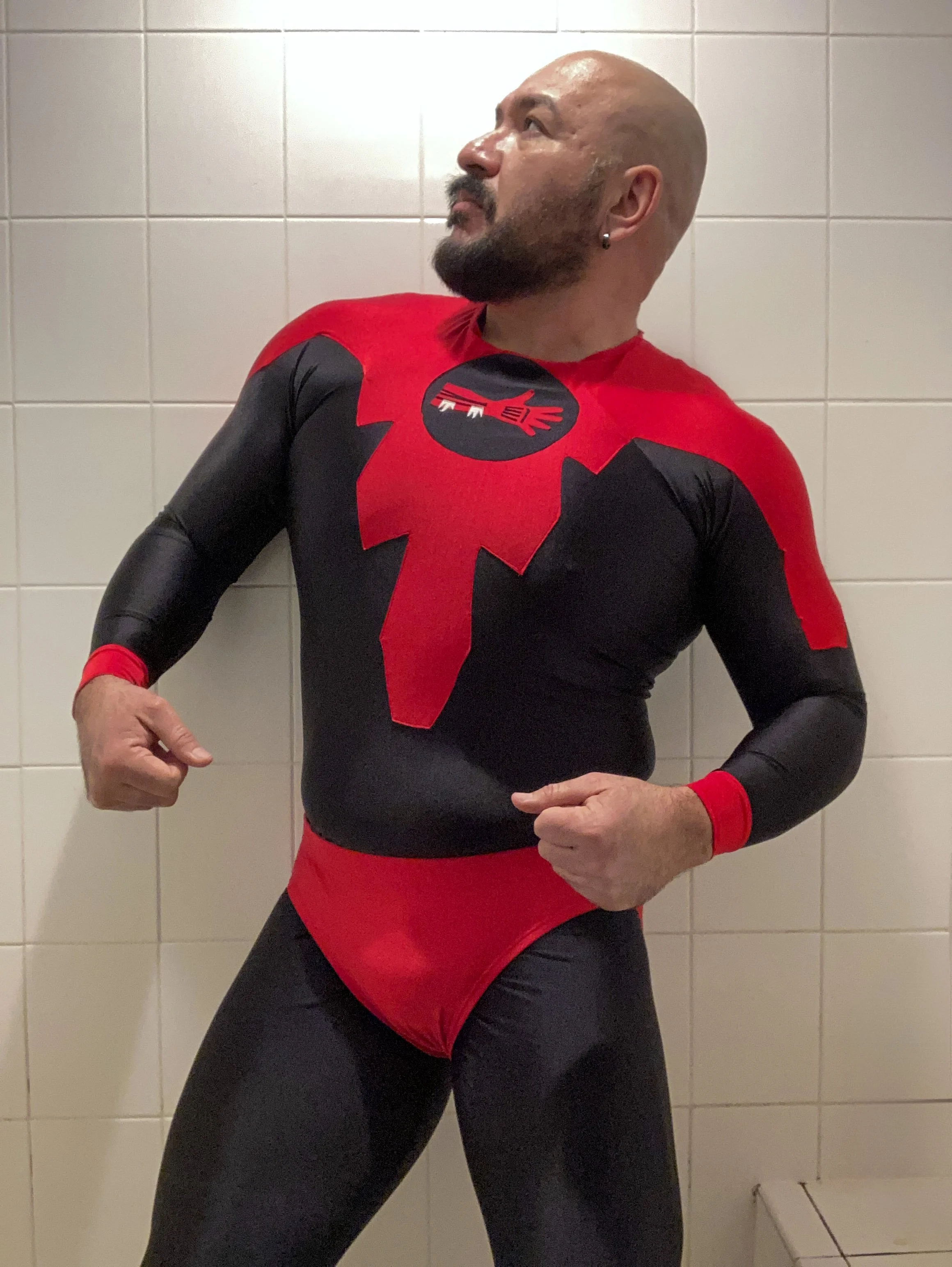
Photo Copyright Cesar Torres
I no longer own this suit. When I trimmed my collection, I parted ways with it. When I see these photos I feel pride in my books, in my Aztec multiverse, and I also feel a touch of sadness. My work habits were out of control in those years. I was a true workaholic, and I don’t miss that part of myself. But I do feel a lot of joy in seeing these old photographs of the suit, shot at home in my apartment in very natural settings. They reflect a love of cosplay, ny superhero fetish, but most importantly, they reflect my artistic collaboration with Shane, who is both kind and creative.
Your Feedback
What’s your experience of the original book cover and the matching spandex superhero suit? Let me know.
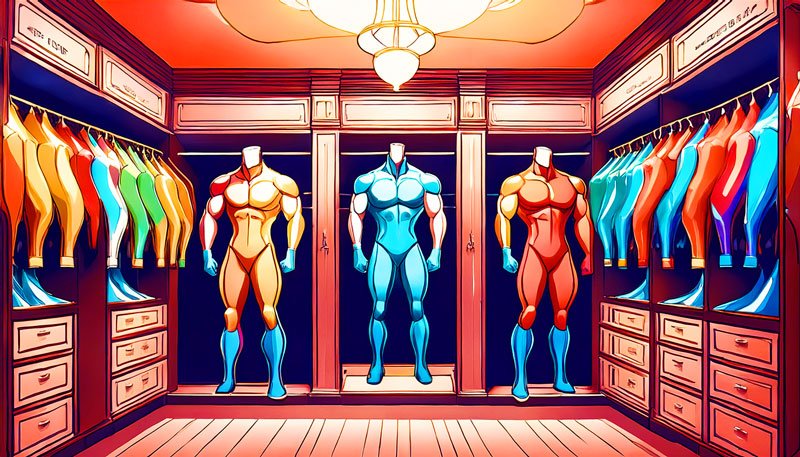
The Stefan Pendley Effect: Why I’m Choosing Archetypes Over Cosplay and Spandex Hoarding
I recently culled my entire spandex collection—but it wasn't just about making space. Inspired by the lonely museum of suits owned by Stefan Pendley in HTKS Book 2, I’ve decided to move away from 'collecting' and toward 'curating.' Here is why I am choosing superhero archetypes over physical accumulation, and what this means for my future photography and creative direction.
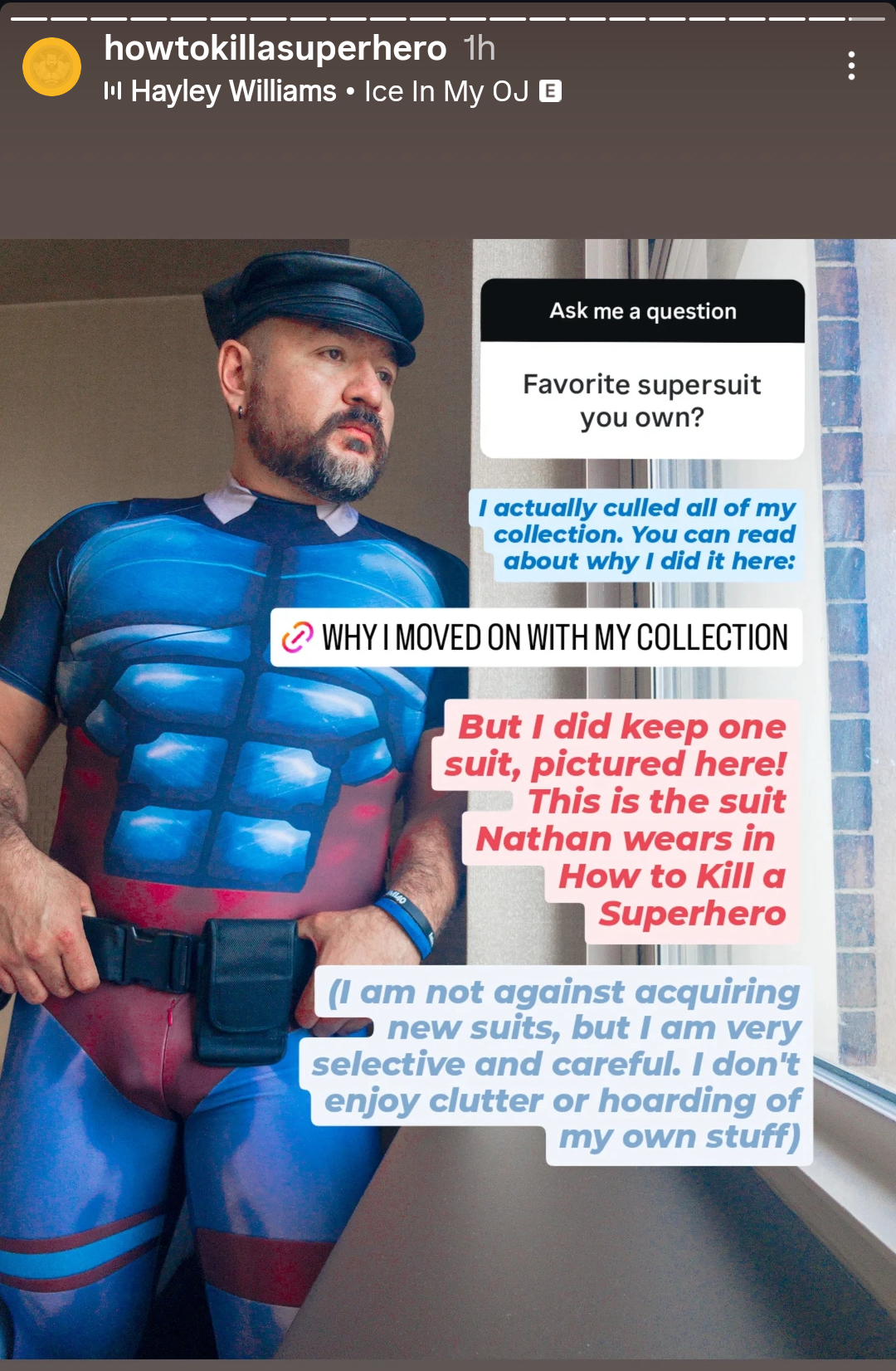
I recently received a question during an Instagram AMA asking me about my favorite "supersuit." The truth is, I’ve culled nearly my entire collection. This wasn't a snap decision; it was a strategic move of self care to align my physical space with my creative mental health.
The Loneliness of a Cosplay Collection
In Book 2 of How to Kill a Superhero, we meet Stefan Pendley. He lives alone in a stunning, luxurious house in Australia, surrounded by one of the world's most expensive collections of superhero gear. It’s so abig and amazing that in fact Stefan’s nickname in the series is “The Skin Collector.” While his cosplay palace looks like a dream on the surface, writing Stefan’s loneliness affected me deeply over the years. He uses these suits to fill a void—to play at being something he isn't quite ready to be in real life. He uses this suits hoping he will be able to connect better with people, yet he is quite lonely.
I realized I didn't want to live in Stefan’s world. I didn't want my home to become a museum of "potential" versions of myself.
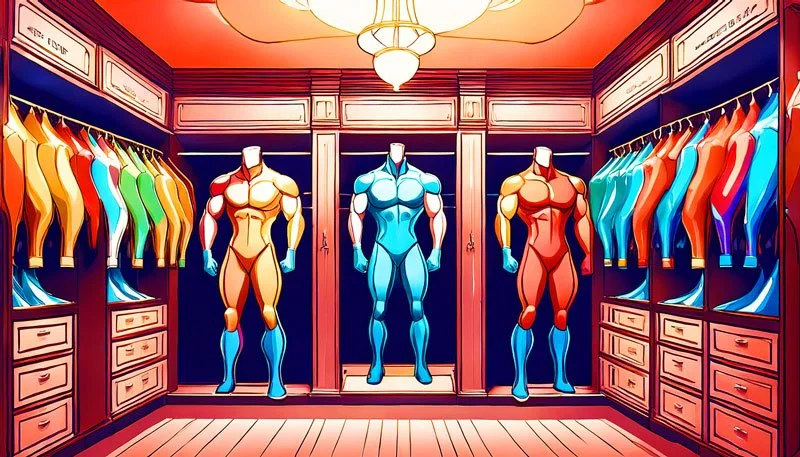
This is a rendering Cesar created to imagine what Stefan Pendley’s dazzling superhero spandex collection would look like in World Without Daylight. Copyright 2025
Superhero Photography & The Future
To be clear: I am not "done" with the hero and villain imagery I am known for. I am still fascinated by superhero and villain archetypes. I am more open than ever to new photography projects and creative collaborations that explore these icons. If you are a cosplayer, photographer, illustrator or videographer and you want to collaborate with me on new projects, contact me.
But my relationship with the stuff has changed. I am no longer interested in the "hoard." I want to be selective, careful, and intentional. I want to step into a suit for the art of the shot, and then step out of it without the weight of a growing collection in my closet.
Going forward, I am always glad to borrow, rent and temporarily build suits, looks and cosplays that help me tell stories about heroes and villains. As you know, satire and a critical lens toward the psychological damage we often incur as fans of superhero stories must be expressed from within the community. That’s where I come in. I can hold two opposites at the same time: I can still keep my love for heroes, villains and their spandex, while at the same time amplifying my voice as a critic about these stories and images from the past century and a half in popular culture. That makes me both similar and different than my own hero, Alan Moore. And that’s because superhero stories are part of queer identity, and they have helped many queer people survive and come out of the closet. I can honor that positive aspect while also suggesting to the world that there’s other stories beyond heroes in tights that we need to tell in order to mature and grow.
The Spandex/Pantyhose Crossover
If you’ve read my recent post abut hoarding on my Lord of the Flowers blog, you know that I’ve been thinking a lot about the generational trauma of hoarding. Culling my collection was my way of breaking that cycle before it started.
I’m moving on, not by leaving the archetypes behind, but by making sure they don't own me.
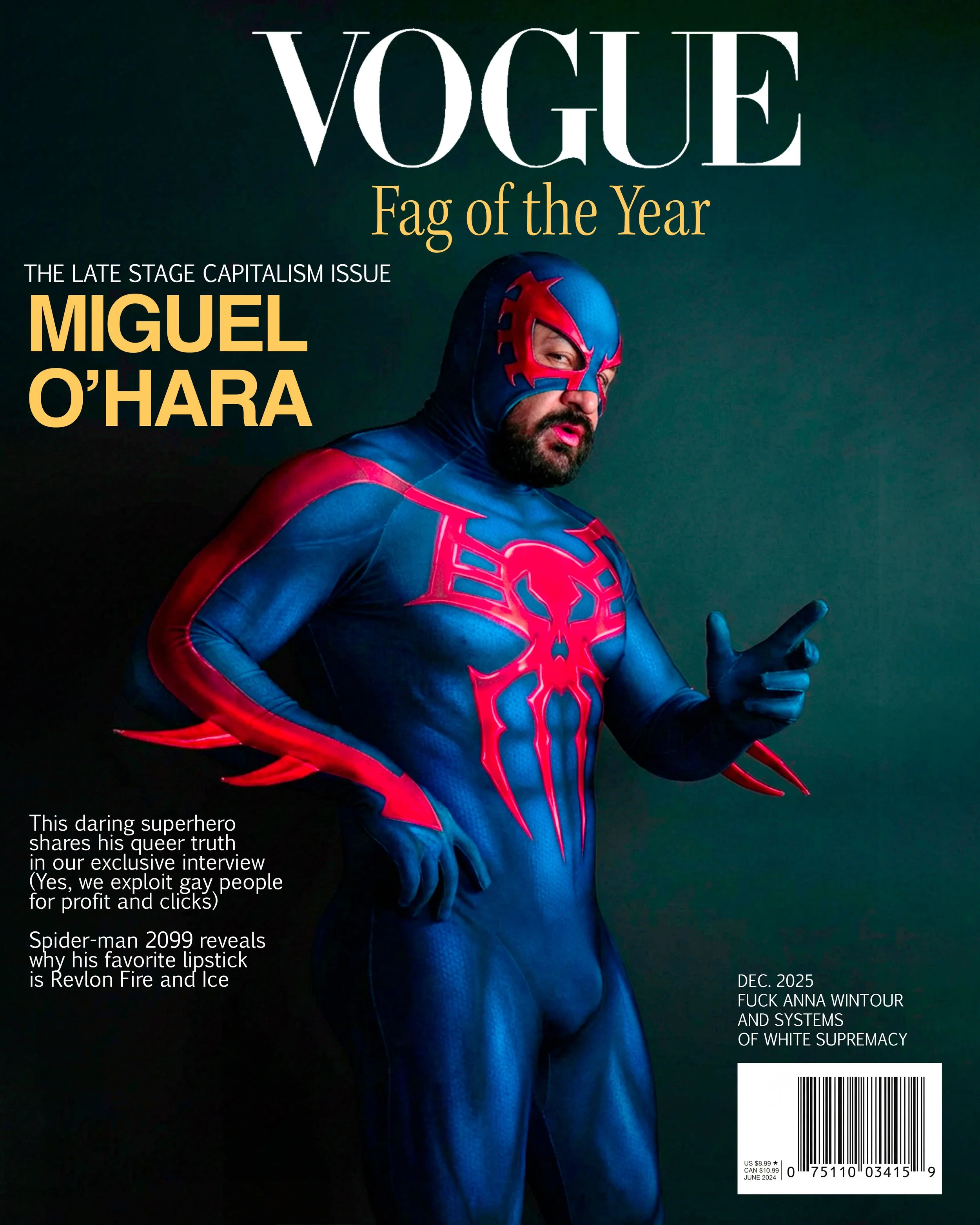
Vogue’s Fag of the Year
Closing out 2025, I’m revisiting my roots in journalism to explore the intersection of superhero lore and consumer culture. This new editorial piece uses Miguel O’Hara (Spider-Man 2099) to satirize corporate branding and explore the "queer coding" of a canonically straight icon.
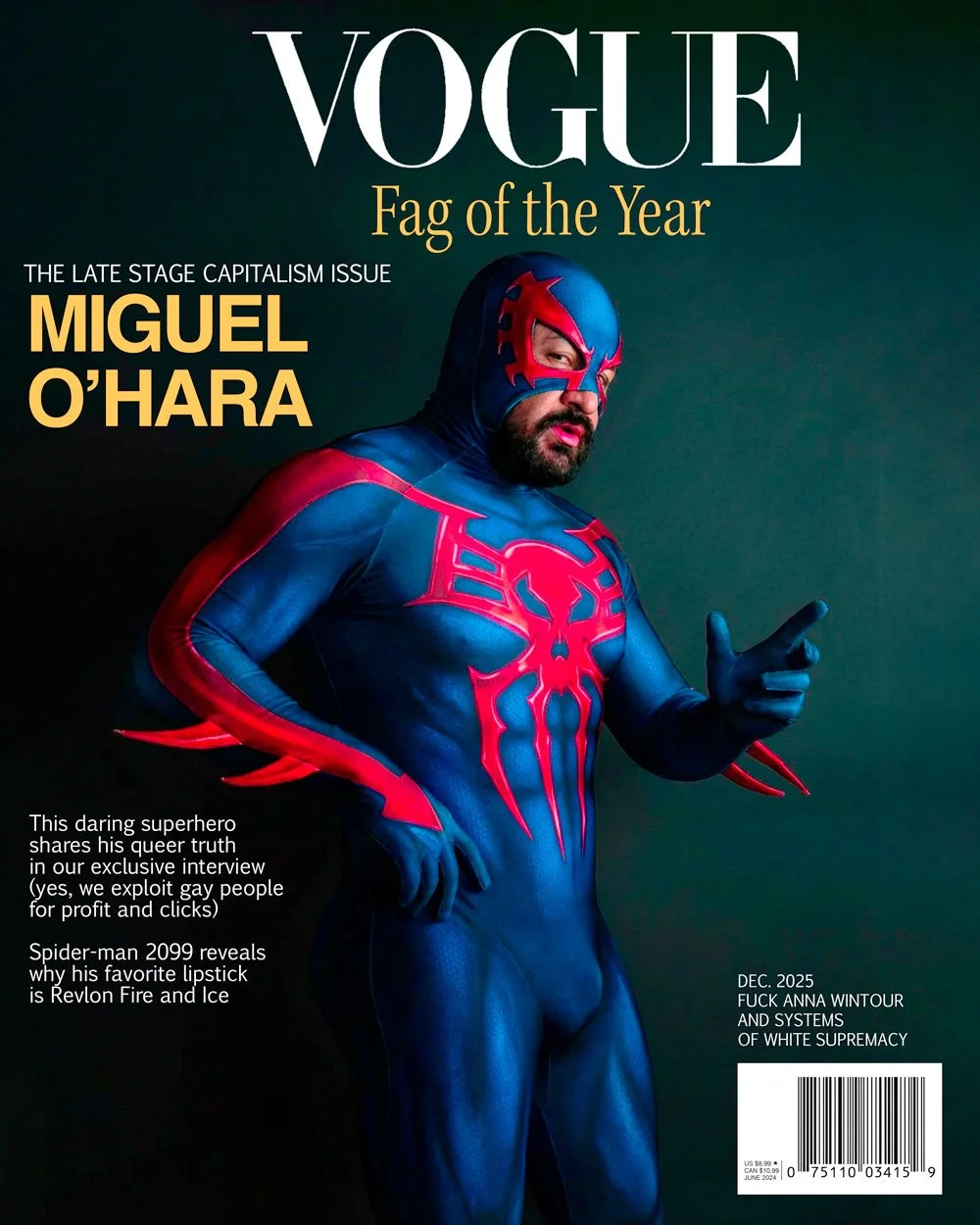
Copyright Cesar Torres, 2025
Today I bring you a brand-new piece of photo art to close out 2025. Recently I have been re-visiting my roots as a journalist and writer, and I wanted to explore magazine layout and typography to constellate ideas about superheroes and consumerism culture. And as I was going through my own catalog of cosplay photos, I decided to take one of my studio shots and turn it into a magazine editorial titled “Vogue’s Fag of the Year.” Just like I did with my Lexcorp photo series, this image uses satire and irony to express ideas. And since Miguel O’Hara is cononically straight in the Marvel comics while at the same time Spider-man as a symbol embodies many aspects of queer identity, I thought, “let’s do this.”
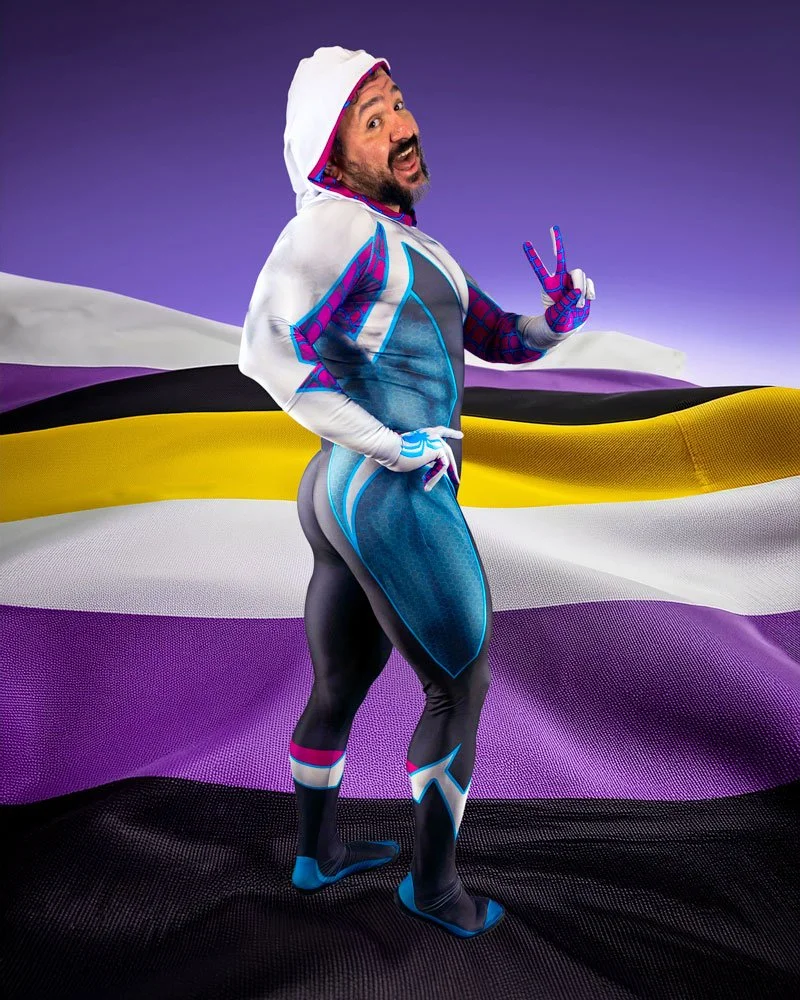
Spider-Gwen as a Queer Icon and My Non-Binary Journey
Copyright Cesar Torres, 2025
For queer folks like myself, cosplay allows us to explore and play with gender. In my case, my gender-bent cosplays from my How to Kill a Superhero era helped me define my own non-binary coming out and gender experience.
What Is Non-Binary Gender Identity?
Non-binary gender identity is the umbrella term for the gender identities of people who don’t identify with the sex they were assigned at birth. Non-binary identity falls outside the traditional binary of man or woman, encompassing people who may identify as both, neither, or a fluid mix of genders. While the term has gained significant modern visibility, non-binary identities are not a contemporary "trend"; they have deep historical roots across various cultures, such as the Two-Spirit people in Indigenous North American societies, the Muxe in Mexico, and the Hijra in South Asia, all of whom have recognized third-gender roles for centuries. To represent this diverse community, Kye Rowan designed the non-binary pride flag in 2014, featuring four horizontal stripes: yellow for those whose gender exists outside the binary, white for those with many or all genders, purple for those who feel a mix of male and female, and black for those who identify as agender. In recent years, the visibility of non-binary identities has reached a mainstream peak through influential public figures and artists such as Sam Smith, Demi Lovato, Janelle Monáe, and Utada Hikaru, all of whom have used their platforms to challenge traditional gender norms and advocate for broader social acceptance.
Spider-Gwen Is not Canonically Enby but Is a Queer Icon
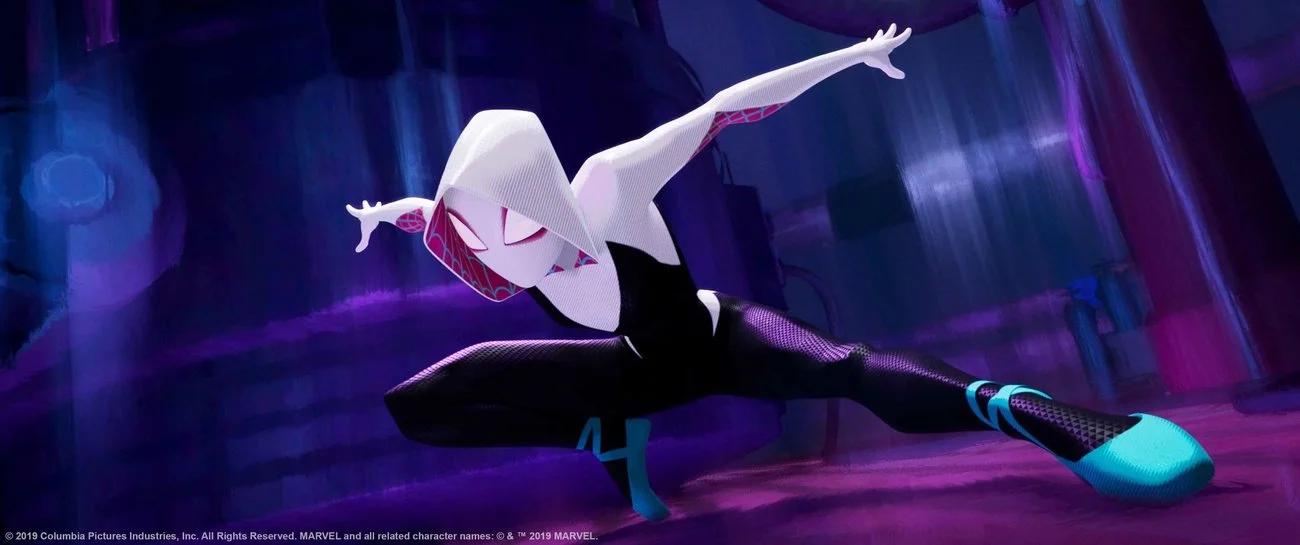
Image via Sony Pictures
While Spider-Gwen (Gwen Stacy) is not canonically non-binary, she has emerged as a powerful queer and transgender icon, particularly following the release of Spider-Man: Across the Spider-Verse. This status is rooted in a rich layer of "queer coding" and visual subtext that many fans interpret as a trans allegory. In the film, Gwen’s private world is adorned with supportive imagery, most notably a "Protect Trans Kids" flag hanging in her bedroom and a trans pride pin on her father’s police uniform. Beyond these physical symbols, the film utilizes a striking color palette of pastel pink, blue, and white—the colors of the Transgender Pride Flag—which wash over the screen during pivotal moments of her character arc. Her narrative journey of hiding a secret identity from her father, the fear of his rejection, and the eventual "coming out" scene where she reveals her true self, mirrors the real-world experiences of many LGBTQ+ youth. By blending these aesthetic choices with themes of self-discovery and familial acceptance, Spider-Gwen has become a symbol of resilience and visibility, allowing queer audiences to see their own struggles and triumphs reflected in a mainstream superhero.
How I Came Out as Non-Binary and Ditched Pablo Greene
During the COVID pandemic, I started to see my gender-bent cosplays in a new way. They expressed what I feel about myself: I have never felt male. Or female. I do know I carry energy of both male and female, but for the most part, I feel that those energies often conflate with culture and societal norms that are often derived from social constructs. If anything, I feel that my gender is something beyond male and female. It’s also why I have always used the word queer to describe myself, since I came out thirty years ago.
As I came to these realizations of my gender, I was also writing a manuscript about a non-binary teen who has to rescue their mother in the jungles of the Yucatan. Though I ended up never publishing that book, the manuscript revealed to me something that was emerging strongly: the need to celebrate my gender identity with pride and no apologies.
As a tertiary outcome, I also stoped using the pen name and public persona Pablo Greene a couple of years ago. I found him to be way too gendered. He no longer fit me. I stayed with the name I was assigned at birth, Cesar. That’s also the name I use on the rest of my published novels. The name itself is gendered, but in everyday life I play with new ways of writing it in a non-binary style. These new variations are XR and CSR. All caps. For now, they work. I do love the name I originally got, but since I don’t feel part of the binary, I would never dream of using the female version of Cesarea. This is jut further proof to me that gender identity for all humans is extremely individualized and must be carefully explored by the self.
The Photo Session
I took this original photo in my Chicago studio with a seamless gray backdrop, but in 2025 I made a new edit with the non-binary pride flag as a new reworking of the project. It brings both the image and my own intent up to date, and let’s face it, a dull gray back drop is boring.
Your Feedback
Got a reaction to this essay and its photo? Send me a note.
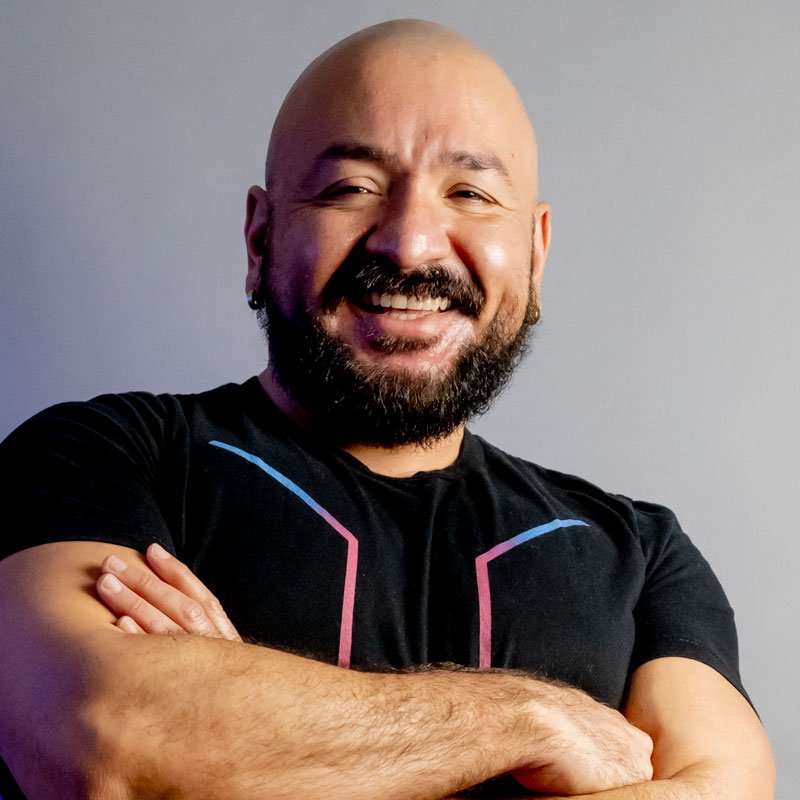
From the Archives: Shave Your Head Bald Like Lex Luthor
Copyright Cesar Torres (2020)
Time to take a journey back in the time machine to 2020, when I made a tutorial for my Patreon subscribers for cosplayers who wanted to become Lex Luthor. The most interesting aspect to me about this video in my Pablo Greene era is that I would eventually go on to embrace shaving my head bald hardcore. Since then, I have been shaving my head daily. I can’t go one day without it, and I love the look for me. It’s been very gender reaffirming also; I came out as non-binary about 3 years ago.
Why I Brought This Back
I like to bring back some of my old YouTube videos for fans who request it. I got DMS asking me to bring this one back to the web site!
Yeah, It’s Cringe to Me
I cringe playing this video back to myself now. Some of the production values were quire nice for a YouTube content creator, but I think the pacing of the video is too slow, and overall, I feel some type of cringe watching it. Now that I move differently as an artist with projects like Our Lord of the Flowers, I definitely struggle to look back at some of my earlier work. But if you found this archival clip entertaining or relevant, please tell me!
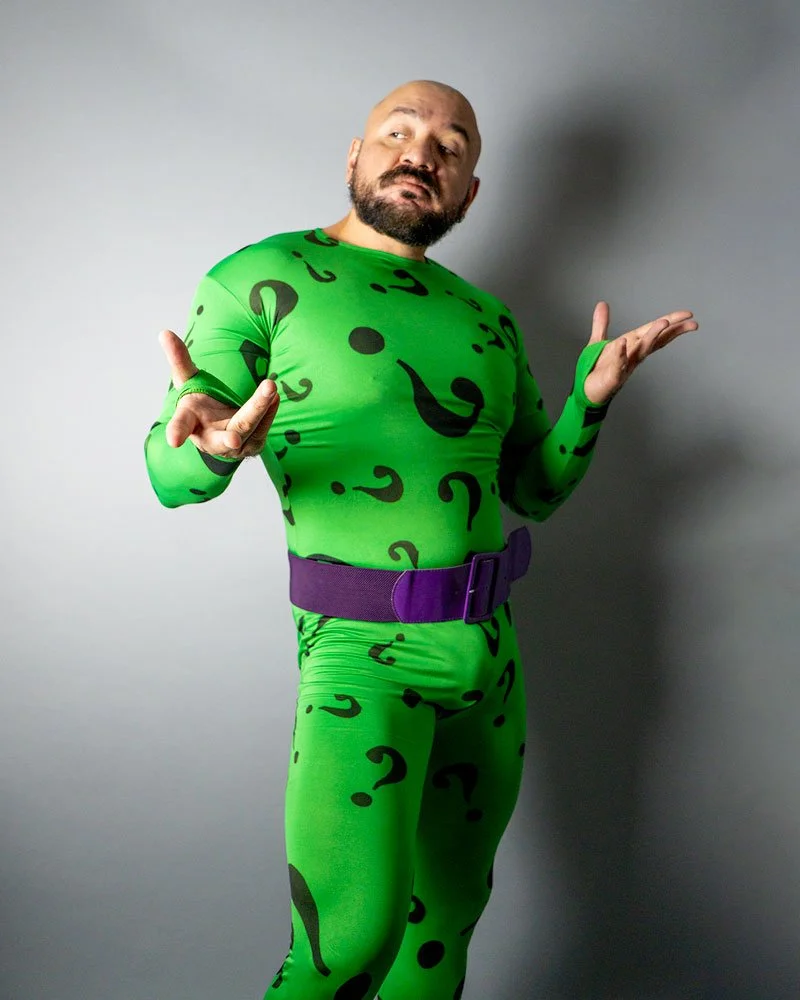
From the Archives: Guess Who???
Multimedia artist Cesar Torres takes us back to 2020 with this spandex cosplay of the character The Riddler, as a way to honor superhero culture, queer art, and self expression. Torres walks us through the process of making this never-before-seen image.
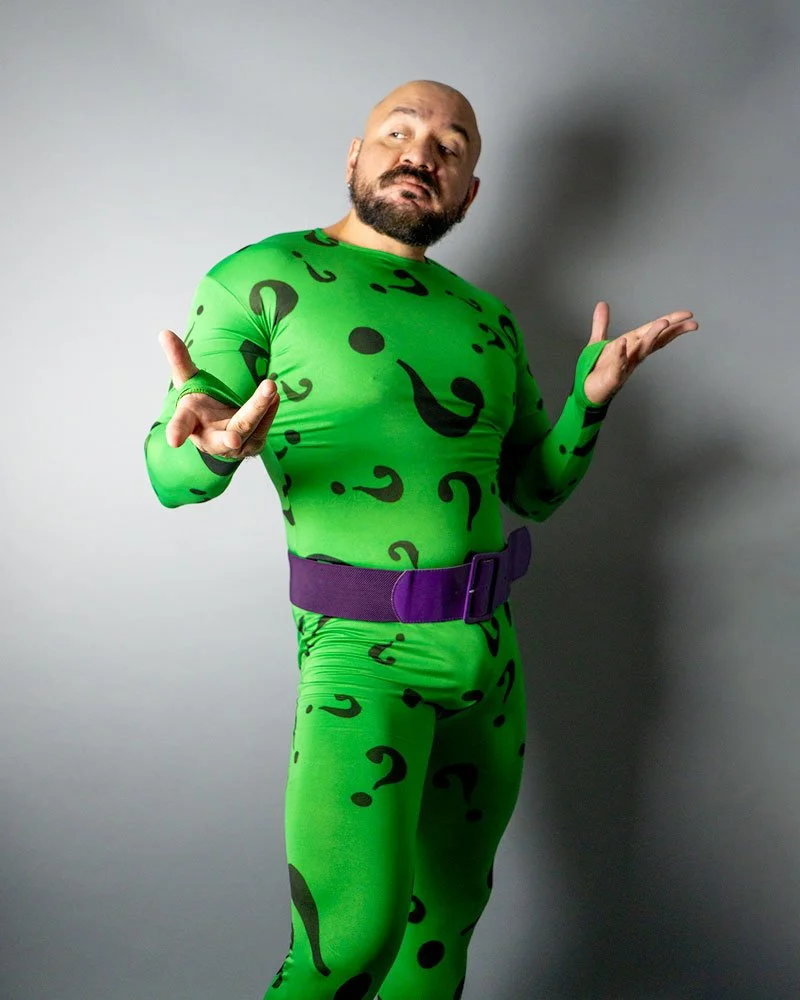
Copyright Cesar Torres (2020)
Today I want to share with you a never-before-released photo of my own take on the Riddler. The Riddler is near and dear to my heart, because symbolically, he embraces ambiguity. Ambiguity is built into the world view of human beings: we will never know all the answers.
About the Process
I shot this on a Sony mirrorless camera in my home studio, using a timer. I edited in Lightroom and Photoshop. What This Image Means to Me
This image definitely captures a lot of my own personal essence in the pose, facial expression, and stance. This image was shot and produced at the beginning of the COVID era, so I can also detect a lot tension in the final composition. That is good. An image should capture a moment in time.
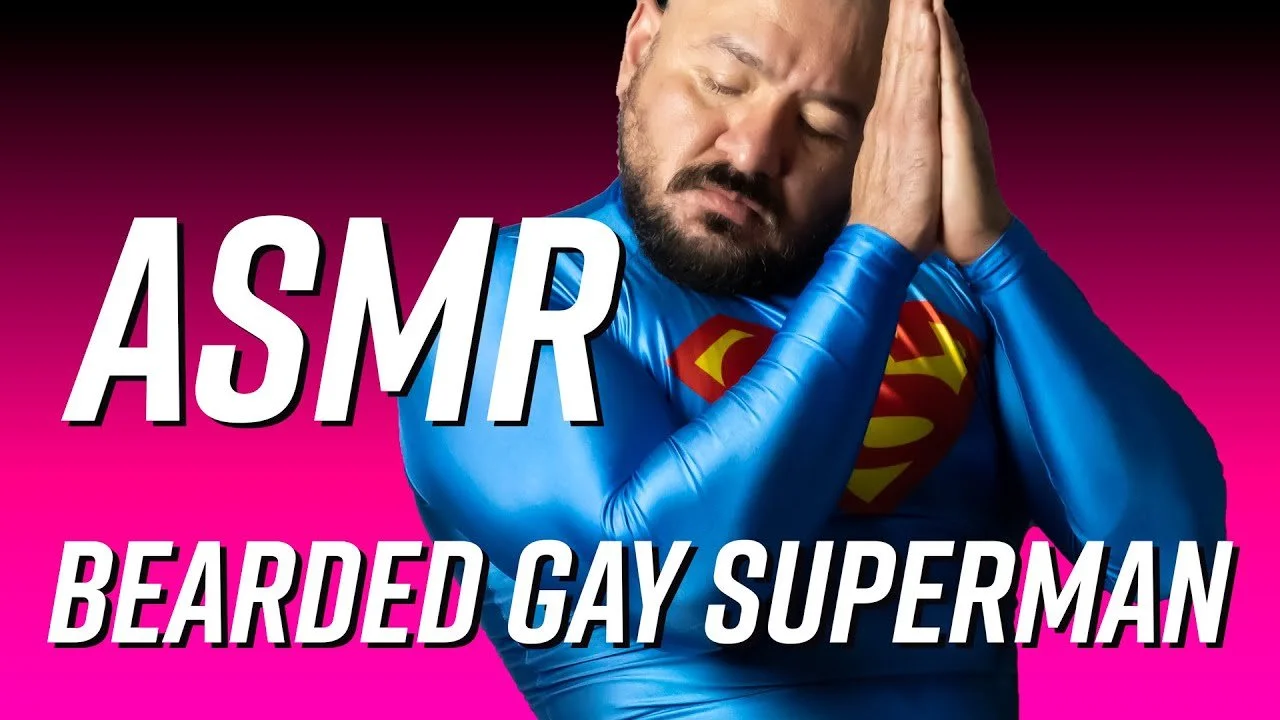
From the Archives: Bearded Superman Chats In Bed
In this archival ASMR video from 2020, multimedia artist Cesar Torres steps into the role of Superman, but this time, Superman’s got a shaved head, and he helps the viewer achieve a relaxed, cozy state of mind. This video has been brought back from the archives to celebrate the versatility of Torres, an artist who works with novels, film, video and photography.
Copyright Cesar Torres (2020)
In this archival ASMR video from 2020, Cesar Torres steps into the role of Superman, but this time, Superman’s got a shaved head, and he helps the viewer achieve a relaxed, cozy state of mind. Perfect to play in the background before going to sleep. This ASMR performance blends superhero mythology, queer intimacy, and sonic storytelling to reimagine the dynamic between hero and viewer.
Revived here as part of the ASMS Archives, it highlights the ways Torres’ early character studies of power and transformation would later evolve into the How to Kill a Superhero novels and photo art.
Support the Artist
If you enjoy this work, you can support its continuation by purchasing books and apparel from the HTKS web store or by sending a direct tip via PayPal. Your support helps keep queer art and storytelling alive.
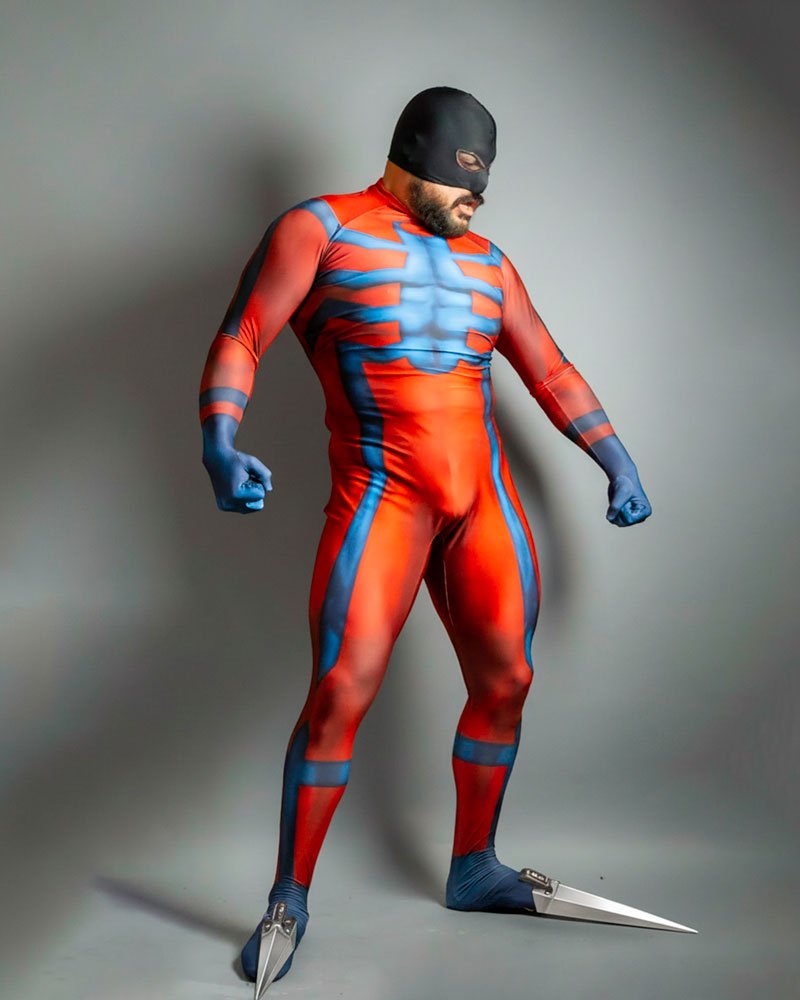
From the Archives: Tarantula ASMR
Cesar Torres revives a 2020 ASMR video from his How to Kill a Superhero YouTube era, embodying Tarantula—the masked villain from Spider-Man—in a performance that blends sound, intimacy, and queer power. Part of the ASMS Archives, it reveals the roots of Torres’ ongoing exploration of dominance, transformation, and myth.
Copyright Cesar Torres (2020)
In this archival ASMR video from 2020, Cesar Torres steps into the role of Tarantula, the masked villain from the Spider-Man universe, to explore the tension between dominance, captivity, and desire. Originally part of the How to Kill a Superhero YouTube era, this ASMR performance blends superhero mythology, queer intimacy, and sonic storytelling to reimagine the dynamic between hero and villain.
Revived here as part of the ASMS Archives, it highlights the ways Torres’ early character studies of power and transformation would later evolve into the How to Kill a Superhero novels and photo art.
Support the Artist
If you enjoy this work, you can support its continuation by purchasing books and apparel from the HTKS web store or by sending a direct tip via PayPal. Your support helps keep queer art and storytelling alive.
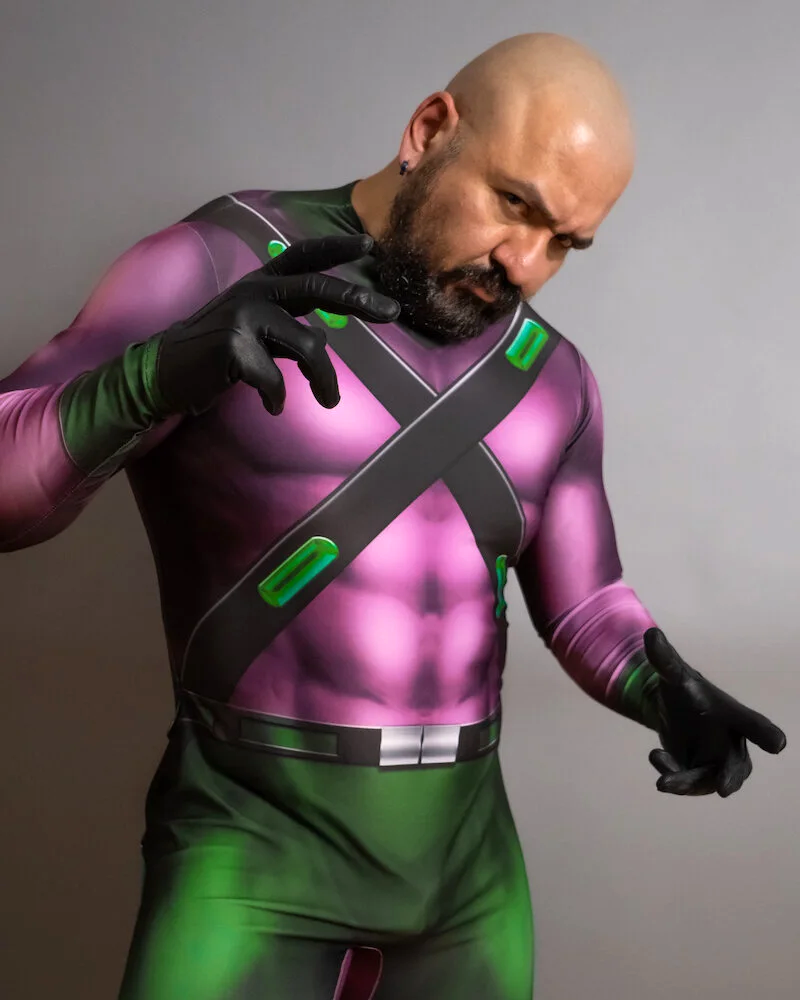
From the Archives: Lex Luthor ASMR
Cesar Torres revives a 2020 ASMR video from his early How to Kill a Superhero era, reimagining Lex Luthor through a queer, sensual lens. Part of the ASMS Archives, this piece reveals the roots of the universe that shaped his later novels and photo art.
Copyright Cesar Torres (2020)
In this archival ASMR video from 2020, Cesar Torres reimagines the villain Lex Luthor through a queer and introspective new angle. Originally part of a series of supervillain-themed videos from the How to Kill a Superhero YouTube era, this piece merges sensual sound design, costume performance, and narrative play to explore the psychology of power, control, and transformation.
Revived here as part of the ASMS Archives, it offers a rare look at the early creative universe that evolved into the novels and art of How to Kill a Superhero.
Support the Artist
If you enjoy this work, you can support its continuation by purchasing books and apparel from the HTKS web store or by sending a direct tip via PayPal. Your support helps keep queer art and storytelling alive.
Review: Fantastic Four, First Steps by Disney
In The Fantastic Four: First Steps, Marvel tries to give its First Family a retro-futuristic glow-up, but the film’s cosmic stakes and colorful visuals can’t save it from a thin plot and lack of chemistry between its leads. I watched it at home and found myself rewinding for the art direction more than the story. While it touches lightly on themes of found family that queer audiences might appreciate, it doesn’t offer any real queer resonance. For me, the highlight was The Thing’s brief but charming romance subplot—proof that even in a universe of superheroes, the small, human moments matter most.
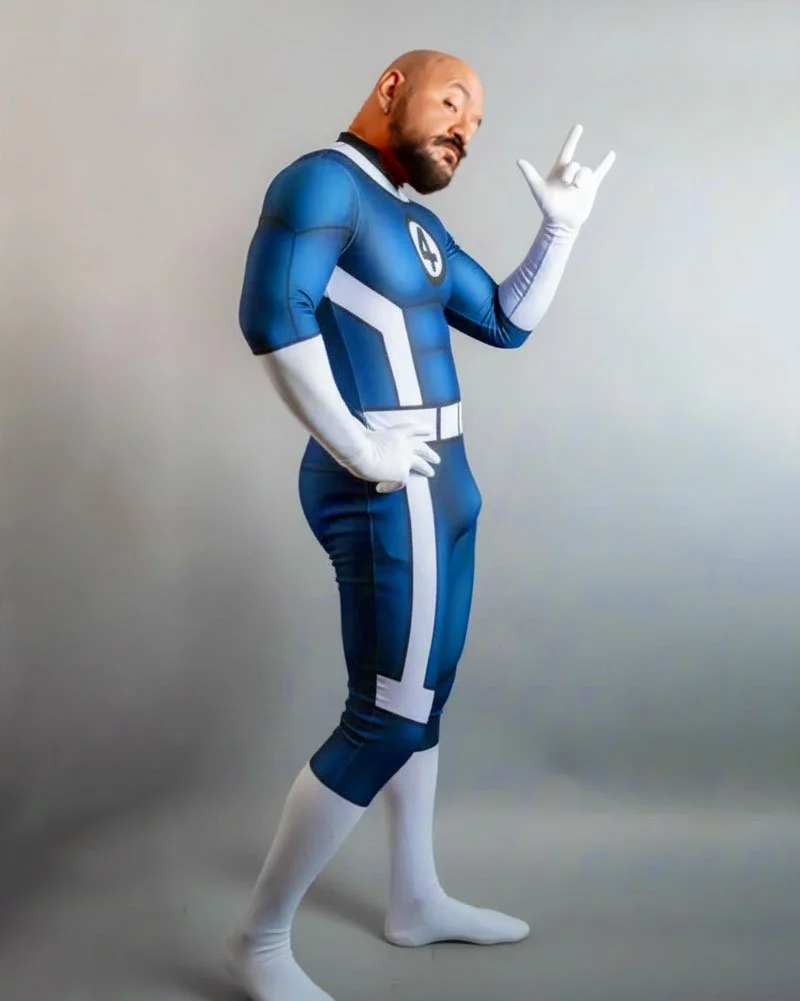
I have always loved the Fantastic Four costumes, and here’s a personal photo in their iconic blue and white spandex. Photo by Cesar Torres
I still get requests from readers of How to Kill a Superhero to share my thoughts on current superhero series and films. My review style is short and sweet, because I am not a movie critic, nor a specialist in film. But I am a novelist, photographer and artist, and I do feel like sharing the way I experience current superhero films.
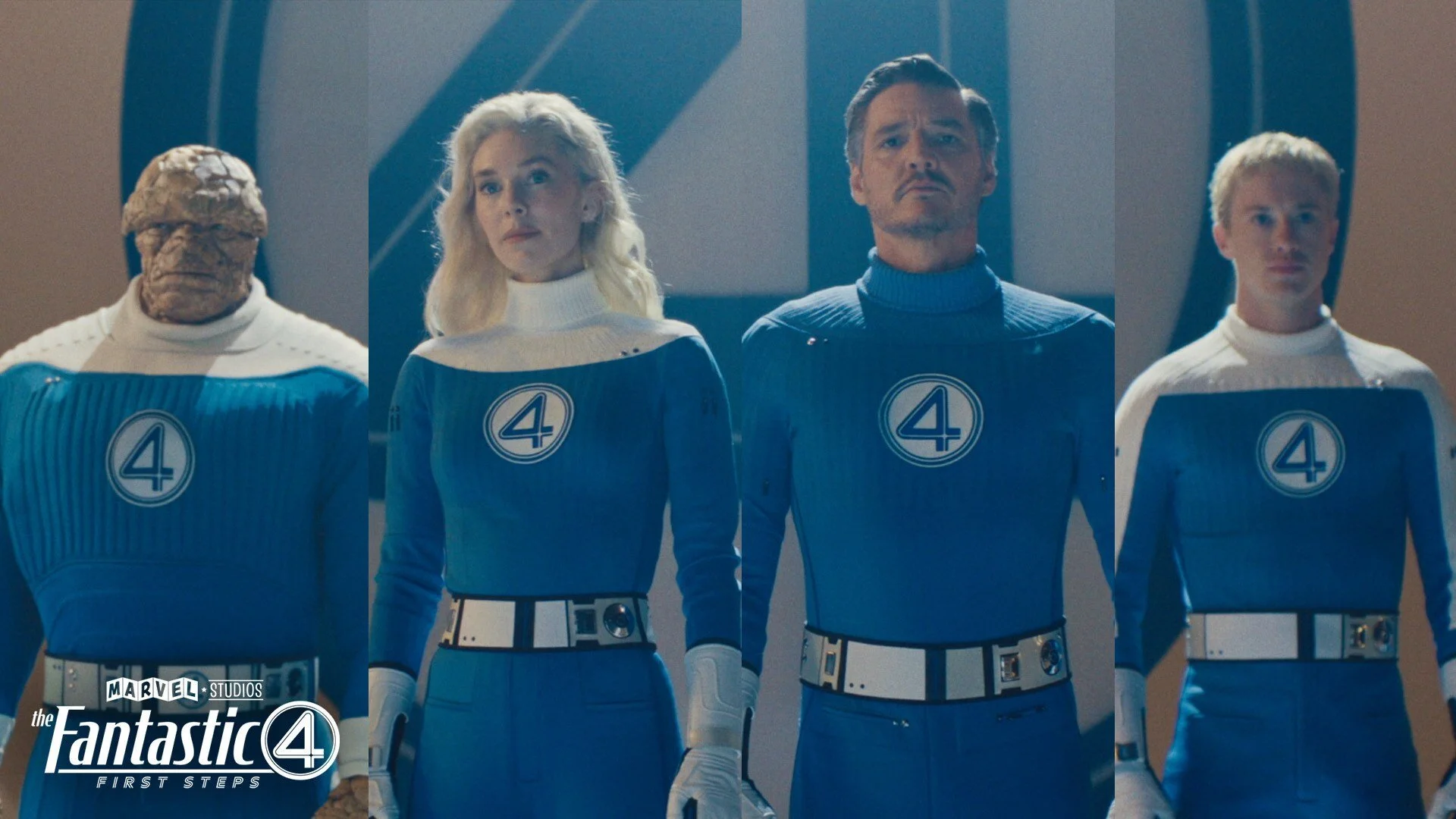
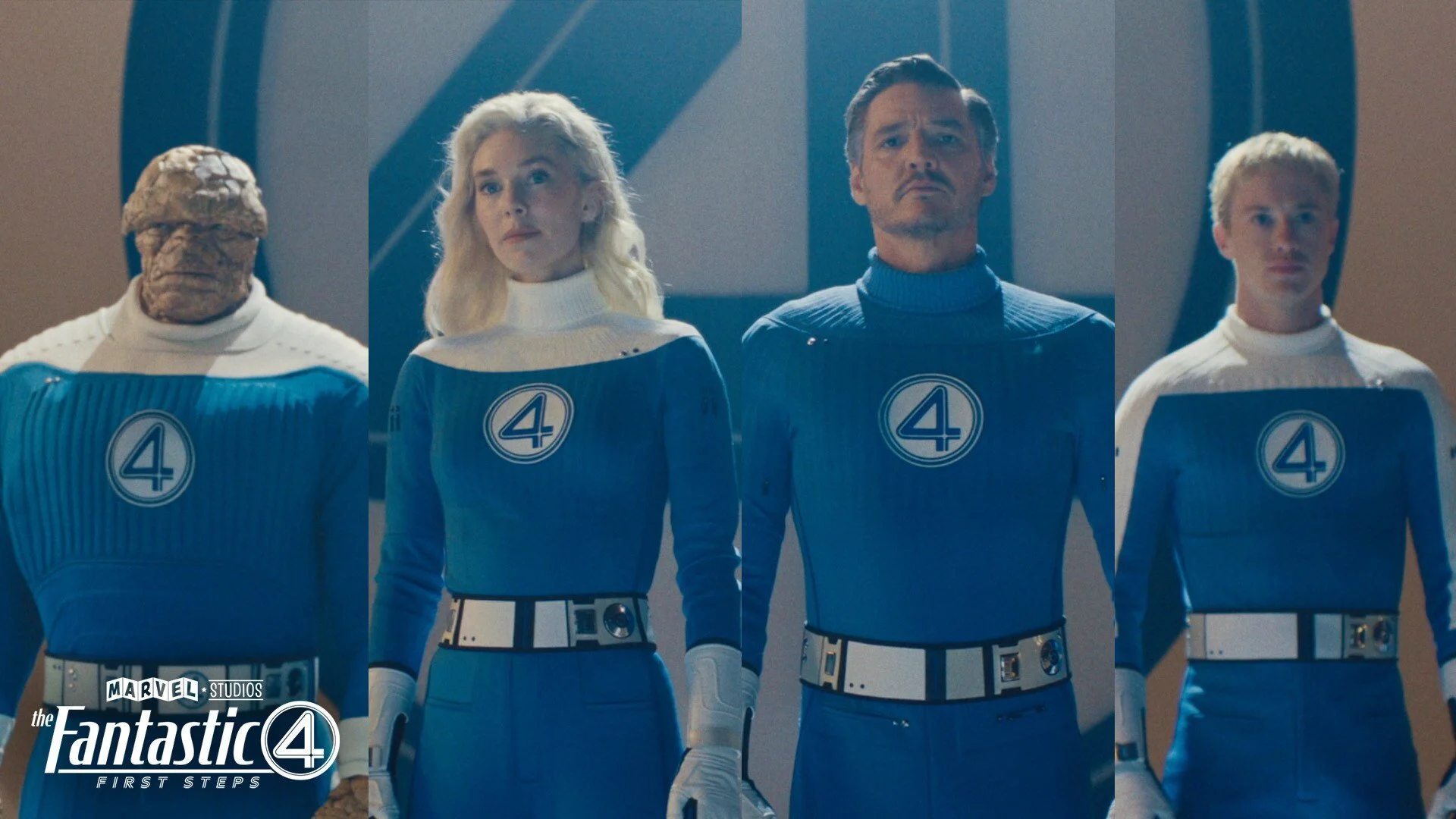
Film Still via Disney
About the film
The Fantastic Four: First Steps is a retro-futuristic, 1960s-styled reboot of Marvel’s First Family in which scientist-astronauts Reed Richards, Sue Storm, Ben Grimm and Johnny Storm — now a more domesticated superhero team — must defend Earth from the cosmic menace Galactus and his herald Silver Surfer, even as Reed and Sue’s expectant parenthood raises personal and moral stakes.
It offers a strong through line about family, sacrifice, and unity — themes that are broadly relatable and emotionally grounded.
As for speaking particularly to queer audiences: the film does not appear to foreground queer identities or relationships explicitly, so it likely won’t resonate as a “queer story.” However — the emphasis on found-family, resistance to public pressure, and redefining what it means to belong or to protect loved ones are themes that can feel meaningful to queer viewers. If you like, I can list a few recent reactions from queer reviewers to see how the film lands among queer audiences.
I Experienced it at Home
I did not see this film at the cinema. I streamed it on the Disney+ app. At home, I enjoyed its epic visuals, the pretty great sound editing, and its colorful, 60’s, Jack-Kirby inspired art direction. I was also able to slow down a few times, rewind to view specific scenes, and take my time enjoying this product and piece of superhero art.
My Thoughts on Its Plot
This is primarily where this film fails. The plot is paper thin, if you ask me, and although the stakes are sold to us as if they are really high, it felt contrived.
The intro of the film aims to establish the conflict and the characters, but it was incredibly clunky and low-tension. It’s not until the F4 team is on its way to discover Galactus for the first time that the film truly begins. The rest of the film was full of many plot holes and WTF moments. The plot was structured mostly to prop up set pieces and not characterization. Compared to Infinity War, Civil War and other MCU hits, this film felt very mediocre. We do know this film will be a building block for the next big event in the MCU Secret Wars, but it mostly felt flat, lackluster.
Lack of Chemistry Between Reed and Sue
I didn’t feel there was any true on-screen chemistry between Reed and Sue Richards. They did not have that intensity as a couple (and parents) that I remember from the comics. Instead, their dynamic felt more like that of co-workers. And in terms of sexual chemistry between Sue and Reed, I felt zero as a viewer.
The Thing Had the Best Story
The flirtations between Natasha Lyonne’s character Rachel Rozman and The Thing was honestly the best part of this film. In fact, I feel that telling just their story alone would have been an absolute banger. They had chemistry. They had conflict and also a sense of place. And yet, we only get a few minutes of this charismatic pair on screen. This just goes to show that Disney and its directors are only focused on profit, product testing as a way to drive plot, and merchandizing. But what I crave as a viewer are real stories of relationship. The best relationship in this film was that of Rachel and the Thing’s.
Costume Tradeoffs with Disney
I have discussed at length over the years the way that Disney has chosen to flatten out and cheapen the costumes of many superheroes and villains since the MCU ramped up, and the iconic costumes of this superhero family really came off as mediocre. After all, we must remember that when it comes to spandex, the Fantastic Four did it many decades ago. What we got in this film were a few unique looks, including space suits, woolen jumpsuits and branded gear, but wow was it lacking any sense of originality or sexiness. For those of us who love seeing male characters in spandex, it was utterly disappointing. And the irony is that Reed Richards needs very stretchy gear because of his superpowers, and yet we got costumes that looked bulky, flattened muscles, and in many scenes didn’t even look real. This movie is a skip for those of us who like our superheroes to be sexy.
Is It Worth Watching?
I think you can skip this one. I hope its further tie-in to the next MCU phase can help it recover, but First Steps was dull as hell.
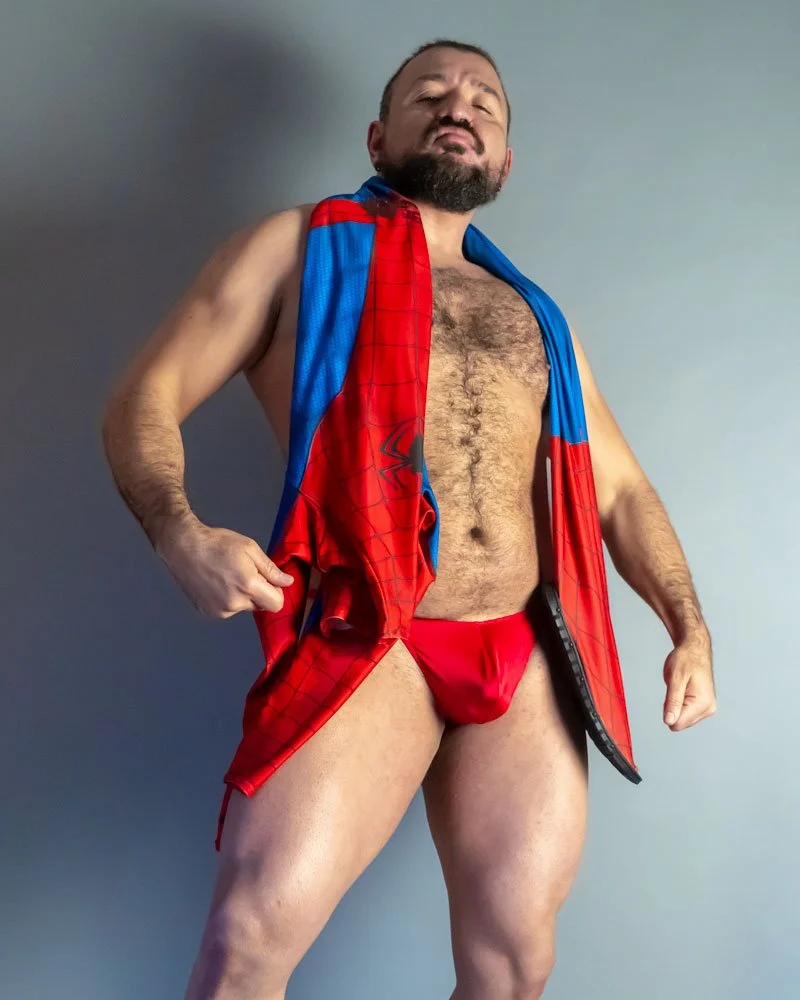
Why I Got Rid of My Spandex Cosplay Collection
After finishing my How to Kill a Superhero series, I found myself surrounded by more than a hundred custom superhero costumes—symbols of an era that had shaped my art and my identity. Letting them go wasn’t just about clearing space; it was an act of grief, release, and renewal. In this essay, I share why I retired my costume collection, how I passed it on to readers and kinksters, and what creative transformation came next.
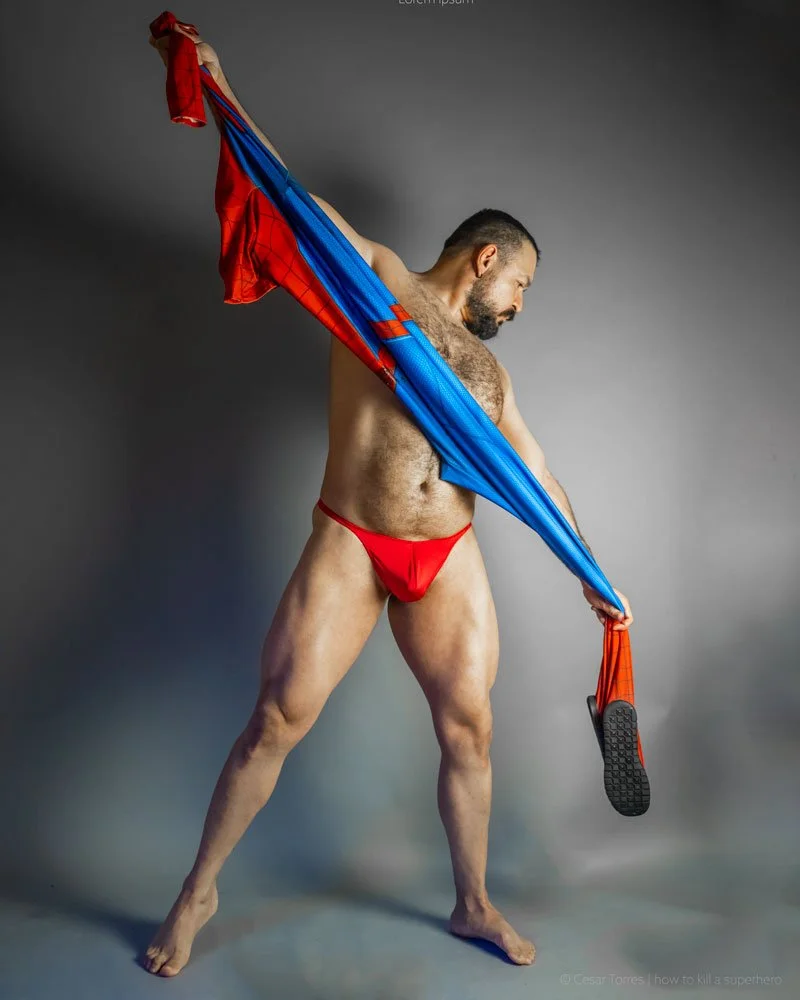
Photo of Cesar Torres in their photo studio, shot in 2020. Copyright Cesar Torres
It's been a few years since I wrapped up my How to Kill a Superhero book series. The first book, A Gay Bondage Manual, was published in 2013, and the fourth and final book, Gold, in 2018. From 2013 through 2022, I generated thousands of photographs that explored my own Mexican identity, queerness, superhero and villain archetypes, and more. Through my work as a novelist and photographer, I explored my own identity while also taking a point of view about the stories of gay and queer folks who grew up with superheroes as a way to survive and validate ourselves.
About two years ago, I decided to retire my vast collection of superhero costumes. I effectively closed the chapter of my artistic and kinky life where I centered superhero cosplays. The principal reason I made this choice is because of my own personal growth. With my four How to Kill a Superhero books, I have said what I needed to say about both the positive and negative aspects of superhero obsession through a queer lens. And yet, I never lost my passion for my own personal superhero fetish, and it still thrives today. Superheroes are still a huge turn-on for me, but my artistic and kink focus has shifted into new projects like Our Lord of the Flowers.
I recall sitting inside my storage area in my photo studio in 2021, surrounded by plastic crates full of custom spandex suits, masks, tights, dance belts, boots, body paint, and visors, and realizing that this was no longer the right environment for me. I no longer wanted to curate such a large personal collection. By my count, I had about 50 custom suits, as well as many other garments, accessories, and custom pieces in storage. In total, my collection added up to something like 100 custom looks. So I decided to get rid of my collection.
Many of my readers and fans of my Pablo Greene persona often ask me what happened to my costume collection. Today, I answer that frequently asked question for you.
The Driver Behind the Change: Grief
It's important to share from the heart, and in my case, retiring my costume collection was a direct and healthy outcome of grief. Between 2020 and 2022, I experienced grief in multiple dimensions. The main source of grief was from having wrapped up the series of four HTKS books. I loved writing the books, but they also took a toll. I also experienced grief over world events—like the COVID epidemic, the brutality of American police, the further descent into fascism, and the declining reading habits of people.
My relationship to the archetypes of comic book heroes and villains had changed. The costumes still fit me like a glove, but the stories they contained no longer fit me. I wanted to move on not just as a person, but also as a collector. I wanted a certain type of freedom from myself.
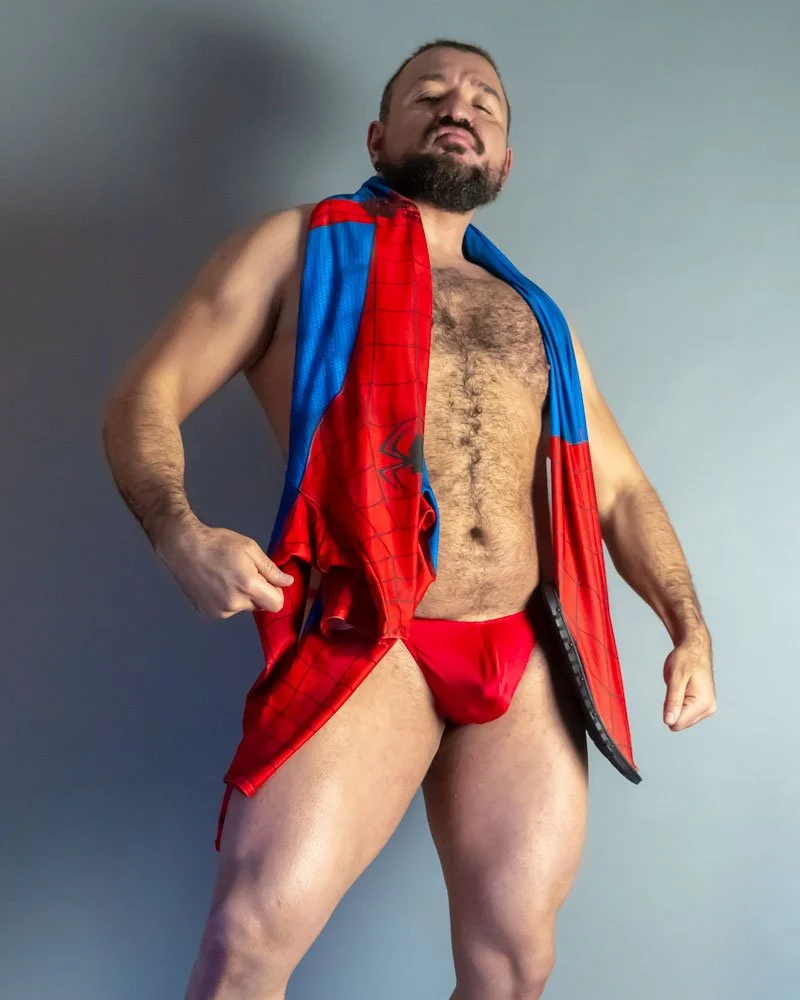
Photo of Cesar Torres in their photo studio, shot in 2020. Copyright Cesar Torres
Sold Many Suits to My Readers
I sold most of my costumes to my readers at very low prices in my store. That was extremely fun, because each time I sold one, I got wonderful emails from readers who had purchased them. They loved the HTKS books, and I’m happy I was able to give them something they really wanted to remember the mutual journey we went on as artist and audience.
I Also Made Kink Gifts
In the world of kink and leather, gifting to younger or less experienced members is a well-known tradition. I gifted a few of my suits to folks who were just starting to experience the kink and leather community. Most of these gifts were accessories, like my Flash cowls, Spider-Man mask shells, and Shazam belts. I’m happy they went to good homes.
Many Things Went to the Trash
This is the most important aspect of what happened to my collection. The difference between being a collector and a hoarder can sometimes blur, and I was worried that I had so many costumes, yet I was no longer photographing them or wearing them in scenes or in public. As I sold off the best parts of my collection and gifted a few items to queer leather folks, I also found myself holding onto many bodysuits and superhero costumes that were too worn out to sell—just a lot of stuff.
So I made a final move that helped me the most: I threw out the remainder of my collection. This may sound sacrilegious to some, but this was my choice to make. I wanted a physical and symbolic transformation, and it was important to start with a clean slate.
To this day, I no longer have any superhero cosplays in my gear collection. I still have other items, and I still engage in superhero play with other kinksters, but I have truly moved on into my newest chapter.
What Happens Next Here on This Web Site?
I have thousands of archival images that I shot inside and outside of my photo studio. Over the next year, I will bring these images to you via this website, my newsletter, and also as digital photo packs for purchase. I’m not against modeling for new photos, but I don’t want to accumulate superhero skins the way Stefan Pendley collects them in the HTKS books.
For me, what matters most is that my novels explored Roland and the Golden Man, and I have the closure I need now that the book series remains in the marketplace and readers continue to find community here on this website.
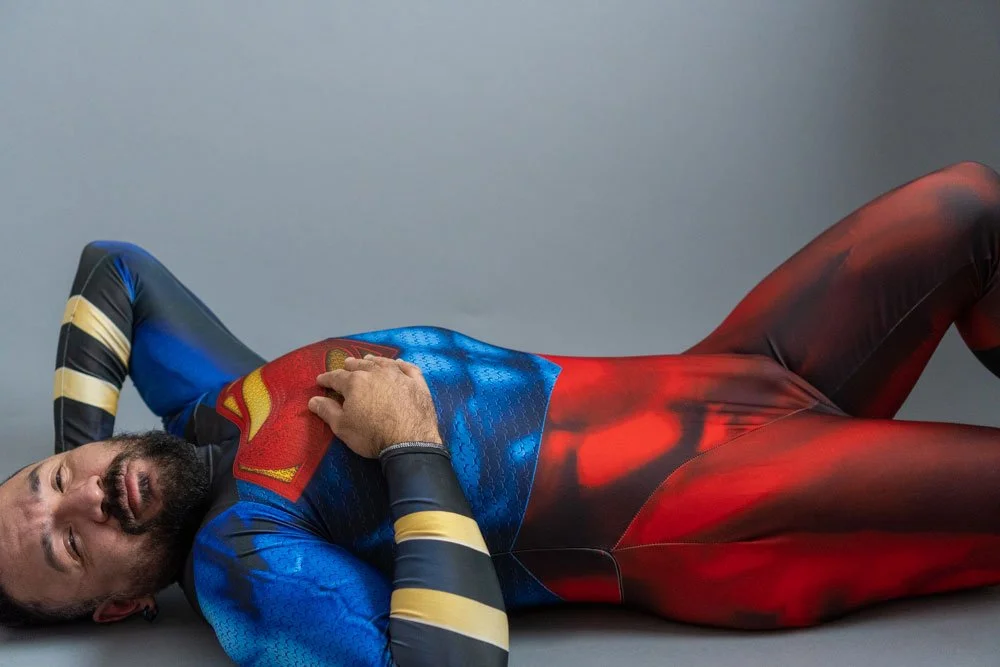
A Photographer’s Memory: Superboy in August of 2019
In 2019 I stepped into a Superboy spandex suit in my home studio — a flash of innocence before the world changed. Seven years later, I’m revisiting those photos not just as cosplay, but as a memory of transformation, identity, and mythic possibility.

Superboy cosplay by Cesar Torres, 2019.
Today I want to take you back to a series of Superboy cosplay photos I shot in my photo studio in 2019. This was a different time, before COVID would change the world, before the collapse of many systems. I want to revisit this creative process so you can see how these images turned out the way they did.
Why Superboy?
To me, Superboy has always invoked images of innocence and naivety. Superboy embodies the archetype of the Fool, visible in the Fool tarot card. This is not an insult to Superboy or his intelligence. It simply means that this hero has yet to encounter his rites of passage, or in some sense, his own failings that life will bring.
I chose to slip into Superboy’s spandex suit for fun as a way to embody this character for my fans, back in summer of 2019. I had purchased this cosplay from the web site Hero’s Time, which used to sell thousands of custom superhero suits, made to order. That web site is now gone, presumably gone out of business. It’s now a memory more than anything.
As a Mexican artist with a beard, I knew that my look as Superboy would go against cultural expectations about the comic book hero. That was my choice to make.
Below you can see one of the final shots from that session.
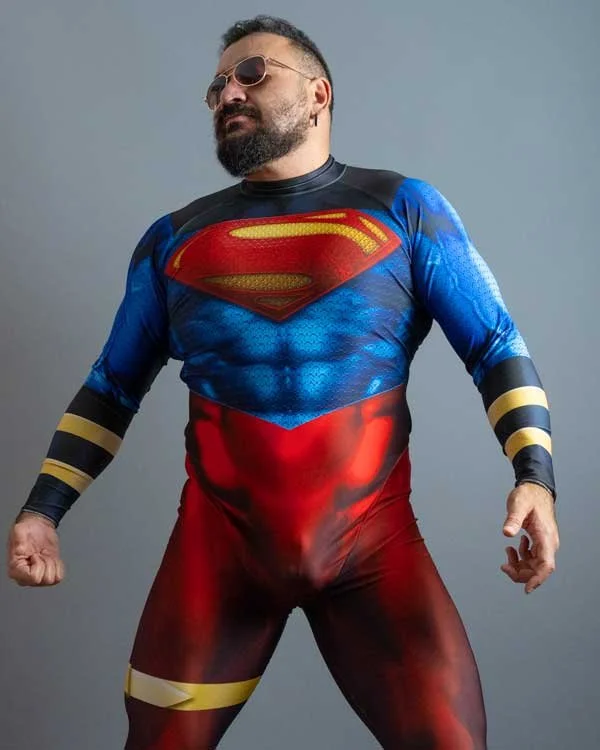
Superboy cosplay by Cesar Torres, 2019.
The Gear and Method
For this shoot I chose sunglasses, to add a touch of mystery and flair, as well as a soft nod to leather culture. I shot this image in my home studio using a Sony NEX-5T camera and some LED lights and reflectors. I used seamless paper, and I shot the images with a timer. This approach to self portraits continues for me to this present day, even though I work with new setups and cameras. I still enjoy the sense of the timer ticking down and giving myself usually 10 seconds to hit the pose.
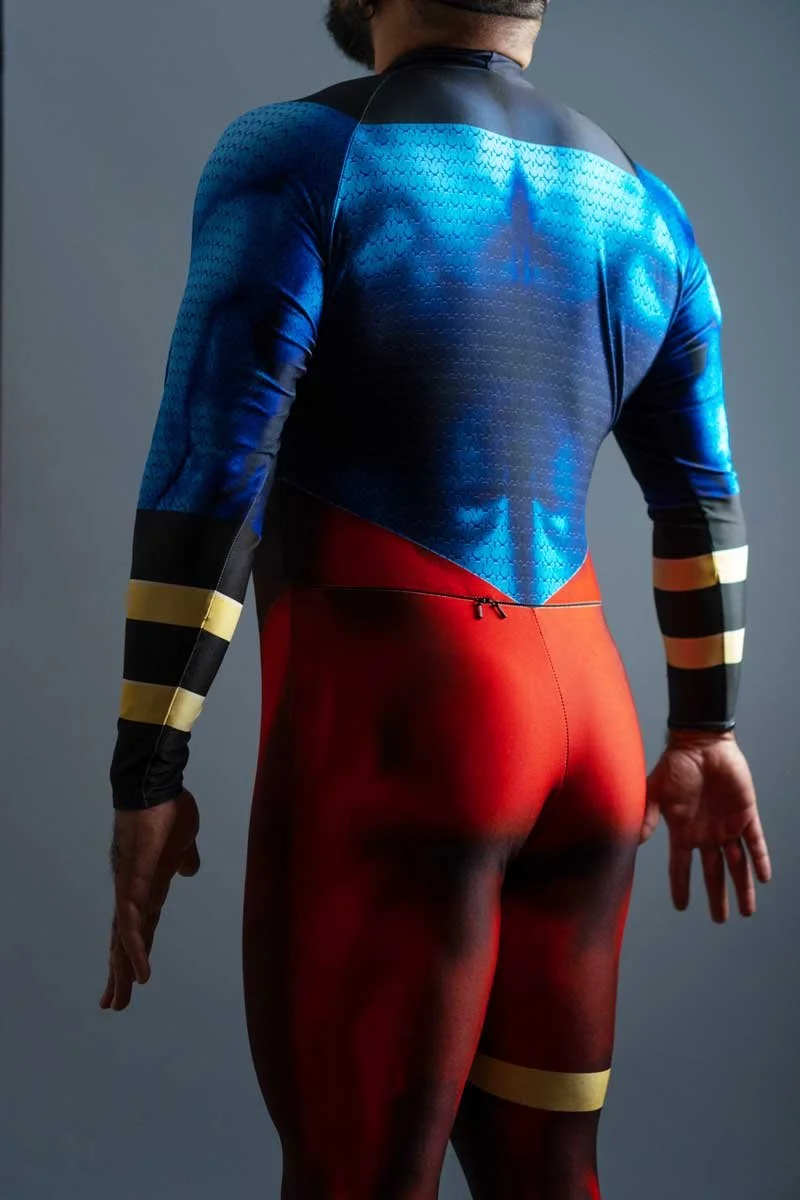
Superboy cosplay by Cesar Torres, 2019.
The Edits
This image was edited in Adobe Lightroom and Photoshop. The only retouching I did was to erase a few stray beard hairs. The end result is a studio shot that I was able to share out with my Patreon subscribers. Since then, I have left the Patreon platform so I can reach you here through my web site directly.
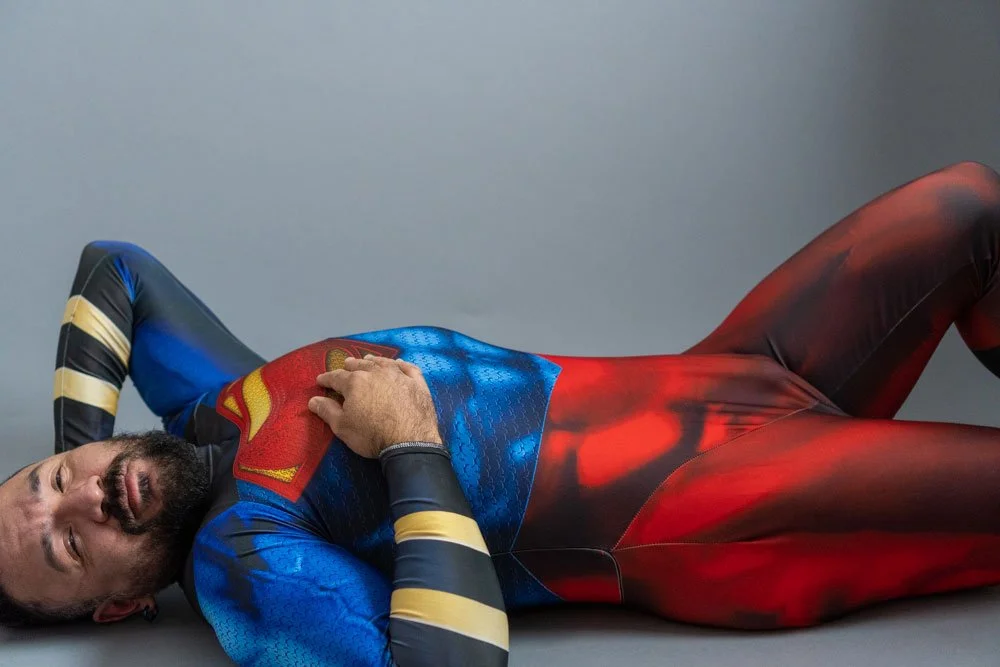
Superboy cosplay by Cesar Torres, 2019.
Your Feedback
What are your reactions to these images of Superboy? And what kind of future posts about my creative process would you like to see more of? Send me a note.
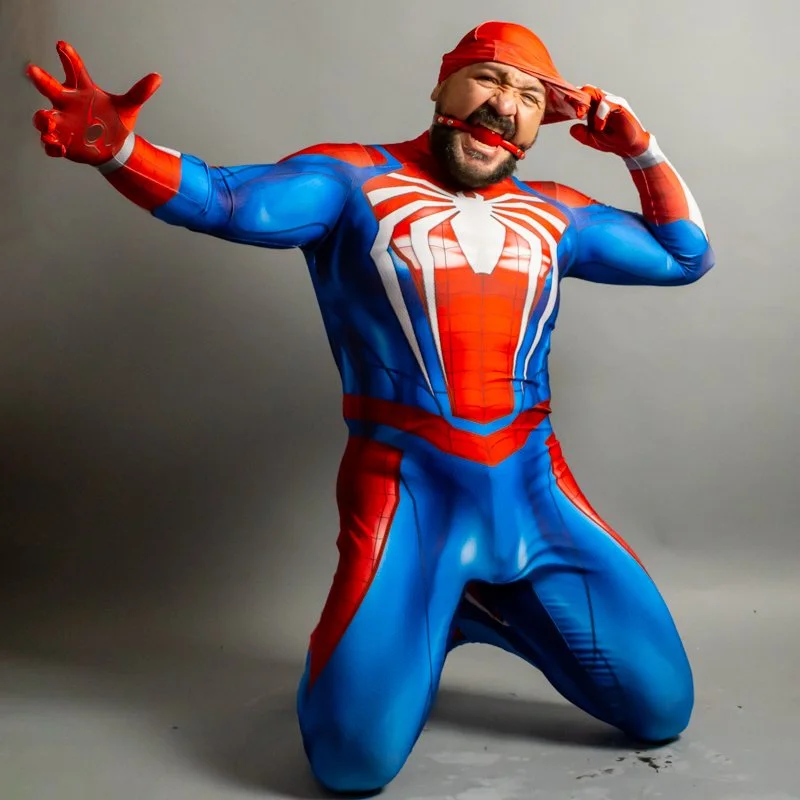
Back In Spandex, Back in the Fight
Back in Your Inbox, Back in the Fight
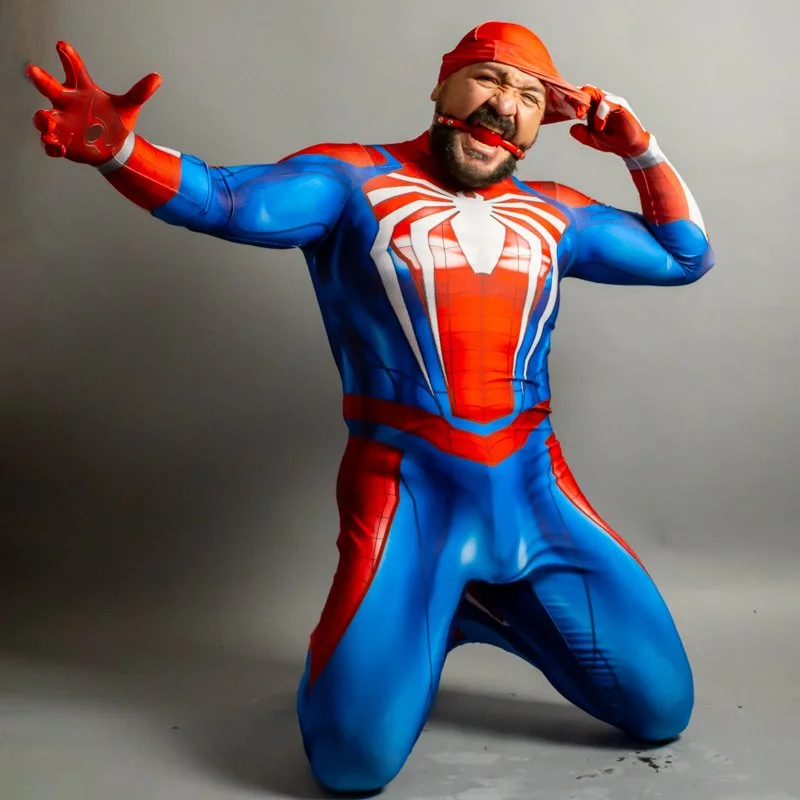
I missed you. A lot.
I stepped away from the Muscle & Spandex newsletter in 2025 because life came at me fast. I spent the year caring for a family member with cancer. In April, my father died. The same day he had the heart attack that killed him, I was laid off from my day job. All of this unfolded against the fascistic slide we’re living through. I’m in Chicago; when ICE swept our streets, kidnapping people and violating human rights, I did what I could to resist with my community.
It’s heavy stuff. But there’s also lots to be grateful for. 2024–2025 also brought real wins. I transitioned LED Queens from retail into services—branding and strategy for LGBTQ/BIPOC businesses—something I should’ve done sooner. I got my creative drive back and put in serious work on two books: Hall of Mirrors (out in 2026) and Our Lord of the Flowers. Art is life. I’m grateful to still be here making it.
And no, I didn’t forget my superhero and villain crew.
Coming 2026: How to Kill a Superhero, Second Edition
The How to Kill a Superhero tetralogy has been going strong since 2013. More than a decade later, I want to give it the polish it deserves. In early 2026, I’ll launch a fundraising/Kickstarter campaign to produce second editions of all four books with:
New cover art
New introductions in each volume
Cleaned-up interiors and typography
(Stretch goal) An omnibus paperback collecting all four books
If you want to support the second edition—or you have specific requests for this refresh—send me an email. Your notes will shape what gets made.
Our Lord of the Flowers Is Live

If HTKS gave you everything you wanted from superheroes, spandex, and BDSM, Our Lord of the Flowers (OLF)brings a new obsession: spandex, pantyhose, masks, and psychedelia—a standalone queer kink novel with a literary edge.
The book follows Sir Vitrum, a Chicago leatherman cleaning out his late father’s hoarded house while navigating gender, fetish, mysticism, and the leather family he’s built. If you loved the raw sexuality of HTKS, this will speak to you.
Visit the OLF FAQ
Browse the free Fall 2025 photo gallery
I’m now fully independent as an author and entrepreneur. If you want to help OLF take off, please subscribe to the free newsletter, shop the store, or—best of all—tell your friends and lovers.

Author Cesar Torres Returns with Our Lord of the Flowers, a Bold New Book of Queer Kink Erotica

After a hiatus that began in early 2021, author Cesar Torres is set to re-enter the literary world with a fresh, boundary-pushing work, Our Lord of the Flowers. Known for the compelling queer superhero narrative in the How to Kill a Superhero series, Torres’s new novel promises an innovative exploration of BDSM, fetish, and queer identity, all set against the backdrop of Chicago in 2025.
Reflecting on the Hiatus
Since their semi-retirement announcement in February 2021, Torres has navigated a period of personal challenges, including a short stint with an autoimmune disorder and the demands of caregiving for a parent facing cancer. These experiences brought unexpected but necessary time away from writing. “It was a painful period,” says Torres, “but also one of reflection and renewal, ultimately bringing fresh inspiration and creative direction for the next phase of my work.”
Introducing Sir Vitrum
At the heart of Our Lord of the Flowers is Sir Vitrum, a retired kink podcaster and leatherman who is grappling with the grief of losing his father. During the day, Sir Vitrum takes on the task of cleaning his father’s hoarded house, and at night he seeks solace in the sensual and thrilling world of leather sex, kink, and fetish. But as he tackles the endless piles of papers, trash, and hoarded objects, he encounters a supernatural entity singing haunting songs from within the walls of the house. Sir Vitrum’s world is rocked when he learns two leather persons in the Chicago community have recently been murdered. Against his own will, he is drawn into investigating the murders while at the same time unearthing family secrets buried within his parent’s hoarded house.
This book intertwines the waking world with a dreamlike exploration of identity and desire, echoing the stylistic choices made in How to Kill a Superhero but with greater directness and even bigger thrills.
Exploring New Themes and Fetishes
In Our Lord of the Flowers, Torres expands the exploration of kink beyond the familiar territories of spandex and bondage to delve into themes of deep submission and gender identity. This novel acknowledges kinks and fetishes that often remain unrecognized in mainstream queer erotica, emphasizing a journey of self-exploration and consciousness. Readers can expect a murder mystery that pushes boundaries and encourages deep reflection on their own identities.
Nods to the Past
Fans of the How to Kill a Superhero series will find familiar elements in this new work, including Easter eggs and cameos, including Roland from the earlier series. Torres’s signature writing style incorporates Aztec gods, and in Our Lord of the Flowers two more gods enter the story, just as the god Tezcatlipoca permeated the original How to Kill a Superhero series in the 2010s.
A Shift Away from Superheroes
Torres acknowledges that saying goodbye to the superhero genre in 2021 was a significant shift. “I have already said and written everything I needed to say about superhero fetish in How to Kill a Superhero. Since the release of that series, I have come out as non-binary and probed deeper into my own identity. In other words, I have moved on to explore my own kinks in a deeper way.” This evolution is evident in the novel’s departure from cape, tights and comics, and now Torres is venturing into the realms of hardcore leather, body modification, D/S dynamics, lingerie, muscle fantasies, pantyhose, bondage, and body modification—along with a few more surprises.
A New Chapter Begins
This new novel will begin releasing for free next week as a serial on Torres’s new Patreon site, Our Lord of the Flowers. Once the serial is complete, it will be available as a paperback and e-book. The book’s chapters will be accessible for free on Patreon, and subscribers can upgrade to a paid subscription for bonus material such as podcasts, fetish pinup photos, and more.
Launch
The first chapter of Our Lord of the Flowers drops on Patreon next week on November 11, 2024. In the meantime, you can reach out to the author on Instagram and X. Please feel free to join the Patreon as a free member, and if you want to seek more value, you can always upgrade later. Enjoy the book.

The Problem with Patreon, and Why I am Leaving their Platform
Today I am writing to you to alert you to cumulative problems that have been developing on the platform Patreon over the past three years. I have been a client of the Patreon platform since 2017. Over the years, I tolerated many of those issues because I needed to make money as an artist to survive, and back then, the company seemed to have benign intentions. But the problems have become more frequent and chronic, just as the Patreon platform has also transformed into a corporate entity that is moving away from being a grass roots organization. Patreon has raised $90 million from investors, and it is valued at $1.2 billion. They have raised $255 million as of September 2020. Back in 2019, CEO Jack Conte told CNBC that the company’s business model would have difficulties maintaining a profitable business model unless it made changes. In 2019, Tech Crunch analyzed this challenge, and also forecast that an IPO could be part of Patreon’s future. Fast forward to 2021: the company is said to be planning to go public later this year, and the forecast of what will happen to independent artists and content creators like me is grim.
The future of the company promises to be very corporate. And historically, corporate greed and the arts have never mixed all that well, unless exploitation was factored into the relationship.
Here are a few of my personal issues with Patreon as it relates to my content and personal platform:
They claim to be a content-creation platform, but they are in a bit of an identity crisis. Sure, they provide tools for posting and sharing content, but what they are truly best at is being a payment processor. They are not very transparent about this.
When the COVID-19 pandemic arrived in 2020, Patreon gave content creators no significant resources to optimize their efforts to survive the crisis or the economic recession that has followed. I made my own decision to re-brand, optimize my offerings and pricing models, but I did it all by myself. Patreon gave us nothing that we could use as guidelines or even tutorials to survive.
Patreon has rolled out billing changes that affected my Patreon subscribers negatively. These changes include sudden new changes in fees and billing cycles. The burden was placed on us, the content creators, to relay that info to them, and thus Patreon absolved themselves of the responsibility for that change, even though they are the payment processor in these transactions. Sure, they gave creators templated content for us to distribute to Patrons, but I am appalled that they also wouldn’t message the subscribers directly to back up the messaging from individual content creators.
Patreon staff discriminated against me inside their Discord, marking my own show-and-tell content as NSFW, while describing straight creators’ show-and-tells of a similar visual style as absolutely appropriate for the corresponding channel. In other words, they told me to take my queer content to the back of the bus when it comes to peer-to-peer interactions on their Discord.
That brings us to changes that are happening today that I want to bring to your attention. This week, Patreon announced internally to creators a new billing cycle that will move away from billing you, my Patrons, on the first day of the month, and instead move to a new cadence where you are charged based on the day you join. You can read this Reddit AMA with Patreon CEO Jack Conte here, but please take a read through the comments from content creators. They show a palpable sense of concern that is only met with corporate platitudes from Conte as a result. Patreon has not confirmed if and when this change will roll out, but the community of Patreon content creators has spoken out about how this will negatively impact many creators, and more importantly, how this could also impact the most important folks in the equation: the Patreon subscribers.
Jack Conte will be hosting a town hall meeting tomorrow, February 4 to discuss these new changes, and I will attend. But at this point, I am only attending because I want to stay informed.
On my end, I am taking accountability for myself and my readers and fans, and making a big decision: I am leaving the Patreon platform this month.
My biggest concerns about Patreon are their lack of transparency, disingenuous messaging to their clients (us content creators), and the dark forecast of what will come when they align themselves with corporate interests if they go public. When they have to answer to shareholders and Wall Street investors in the near future, there will only be one priority for the Patreon platform: profit. That will put small creators like myself in the crosshairs of their expansion. What’s more, creators who make NSFW and erotic content will surely be marginalized further than they already are by Patreon’s management team. Erotic content makes up a huge part of Patreon’s content-creator base, and I honestly don’t see how they will answer to questions about censorship and freedom of speech, when they are tracking toward an IPO. I do not have any confidence that their platform will act on our behalf.
And for that reason, I am getting out now, before I run into more challenges with the mediocrity that I experience day by day on their platform.
Luckily, I plan to keep making content and making a living as an artist through the e-commerce of my own web sites howtokillasuperhero.net and LEDQueens.com. I only ever signed up for Patreon as a way to augment my income as an artist when I started making YouTube content in 2017 to market my books, and it’s time now to migrate my efforts to my own platform, where I don’t have a middleman who is more aligned with Wall Street than with novelists, filmmakers and other content creators.
So please come with me in my journey, by frequenting my two web sites: howtokillasuperhero.net and LEDQueens.com, where I am the owner and designer of LED Queens Fitness Apparel. Sign up for our email newsletters, and help spread the word that I am making unforgettable art.
I hope that in writing this post you are able to look deeper at the factors surrounding the evolution of the Patreon platform, and make your own sound decisions based on the evidence you collect. Corporations are not inherently malignant, but unfortunately, many corporations slide into corrupt and exploitative practices motivated by greed. Critical thinking is of the utmost importance right now, and this is my time to put into effect my exit strategy from Patreon so I can continue reaching my audience through my own personal business channel. I wish you the best of luck, encourage you to read widely, and to make strong choices.
Cesar Torres