The Butcher Singlet: A Short History of the Most Dangerous Garment in Wrestling
And why LED Queens brought it back
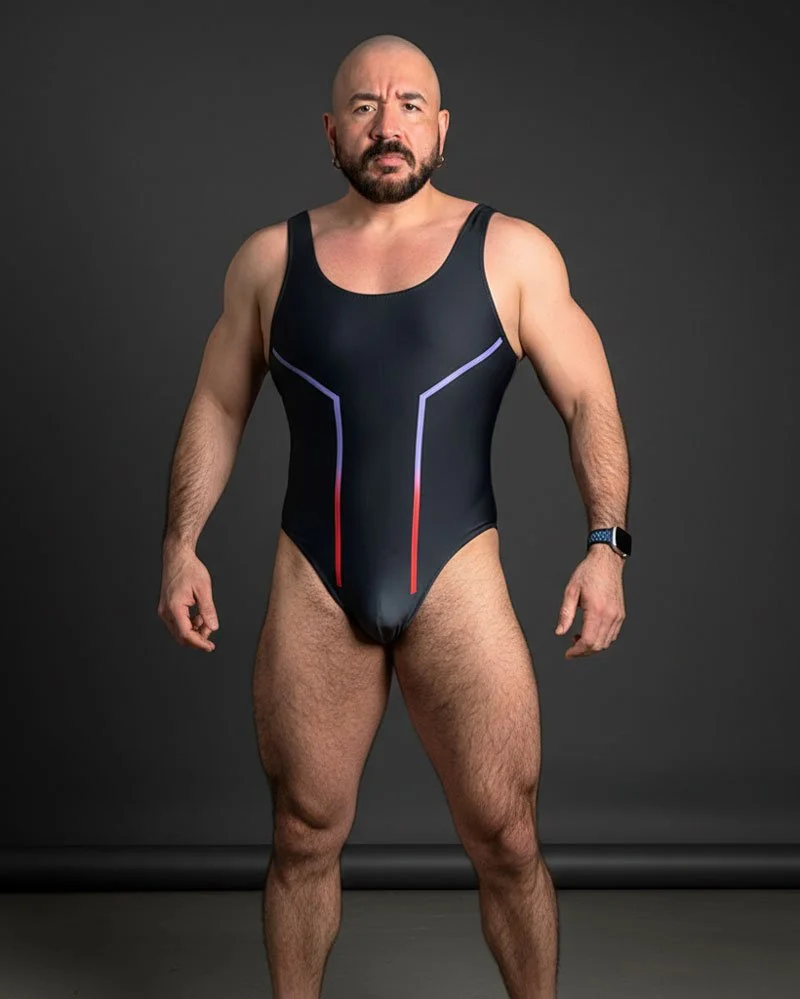
There is a moment, just after you pull the straps over your shoulders and feel the spandex stretch against your body, when you understand exactly what the butcher singlet is for. It is definitely not for modesty. The butcher singlet is for confrontation against your opponent. It's a bold serve: cut high at the hip and tight across the chest while leaving the back exposed. It leaves nothing to hide behind. The butcher singlet turns you into a weapon of spandex fetish and muscle power.
The history of how the butcher singlet got its name is, like most things worth knowing in professional wrestling, not entirely clean. What is clear is that the butcher singlet belongs to a specific lineage of wrestler — the heel, the villain, the rudo in the crowd came to hate and couldn't stop watching. Where the amateur wrestler wore his singlet as a uniform of discipline, the butcher wore his as a provocation for a march. The high cut also reveals the bulge, glutes, quads and hamstrings in a way that a regular singlet can't. In that sense, the butcher singlet indeed is made to slay.
The Evolution of the Iron Athlete: From Strongman to Superstar
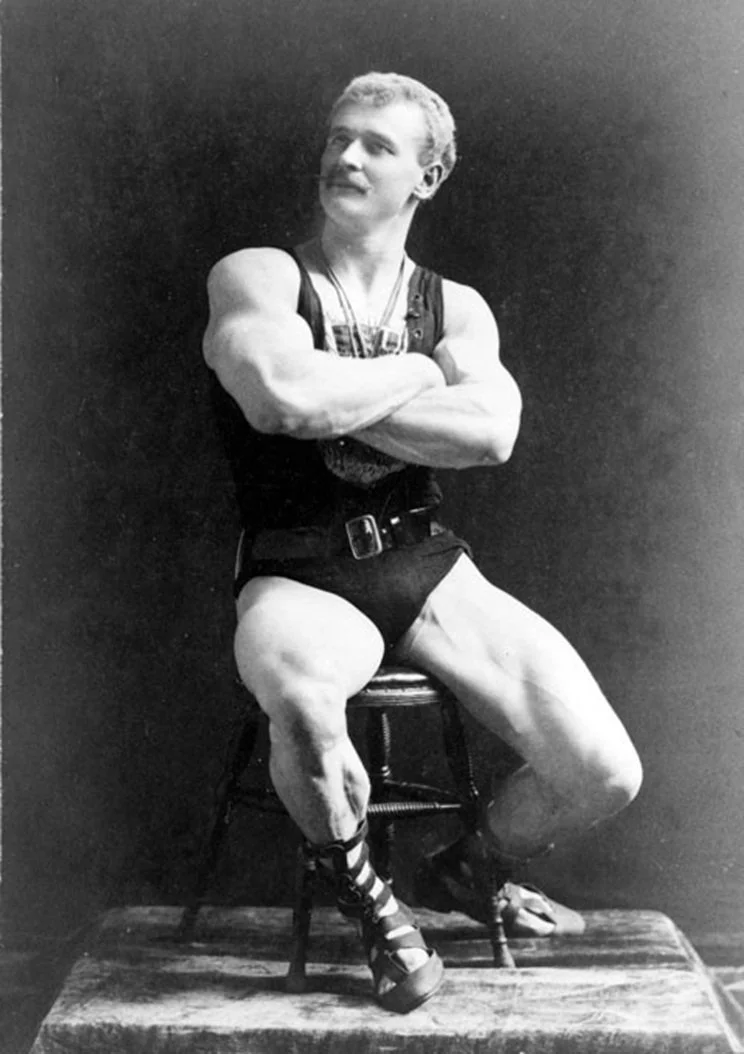
The lineage of the wrestling singlet begins on the vaudeville stage. In the late 19th and early 20th centuries, "strongmen" like Eugen Sandow and George Hackenschmidt needed garments that provided maximum range of motion while showcasing the muscularity that was their primary draw. These early "leotards" or "wrestling suits" were often made of heavy wool, featuring deep-cut armholes and a high-cut leg to allow for deep squats and overhead presses. As wrestling transitioned from a legitimate test of strength to the televised spectacle of the mid-20th century, these functional garments evolved into the "pro singlet"—swapping wool for shimmering spandex and bold, sublimated patterns that could be seen from the back row of a smoky arena.
The Emergence of the "Butcher" Aesthetic
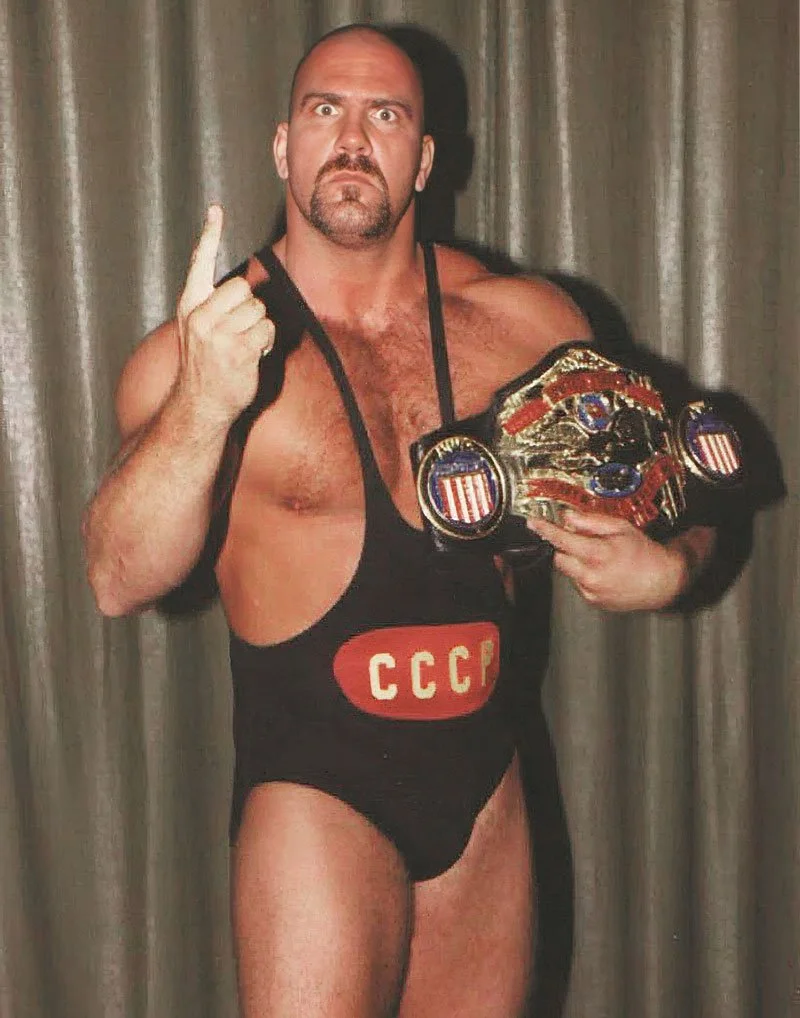
Pro wrestling superstar Nikita Koloff (https://en.wikipedia.org/wiki/Nikita_Koloff)
The specific "Butcher" style—defined by its deep-scoop neck and aggressive vertical stripes—emerged as a solution for the "big men" of the 1970s and 80s pro wrestling stars. Unlike the modest, high-neck singlets of amateur wrestling, this cut was designed to emphasize the "V-taper" of a powerhouse's back and lats. The vertical straps became a visual shorthand for raw, industrial toughness, mimicking the aprons of old-world tradesmen or the straps on the apron of your local butcher. This look signaled to the audience that the wearer was a tough a brawler. It was the uniform of the "Super-Heavyweight," built for the blood-and-guts era of Jim Crockett Promotions and the AWA.
The Modern Legacy: Why the High-Cut Endures
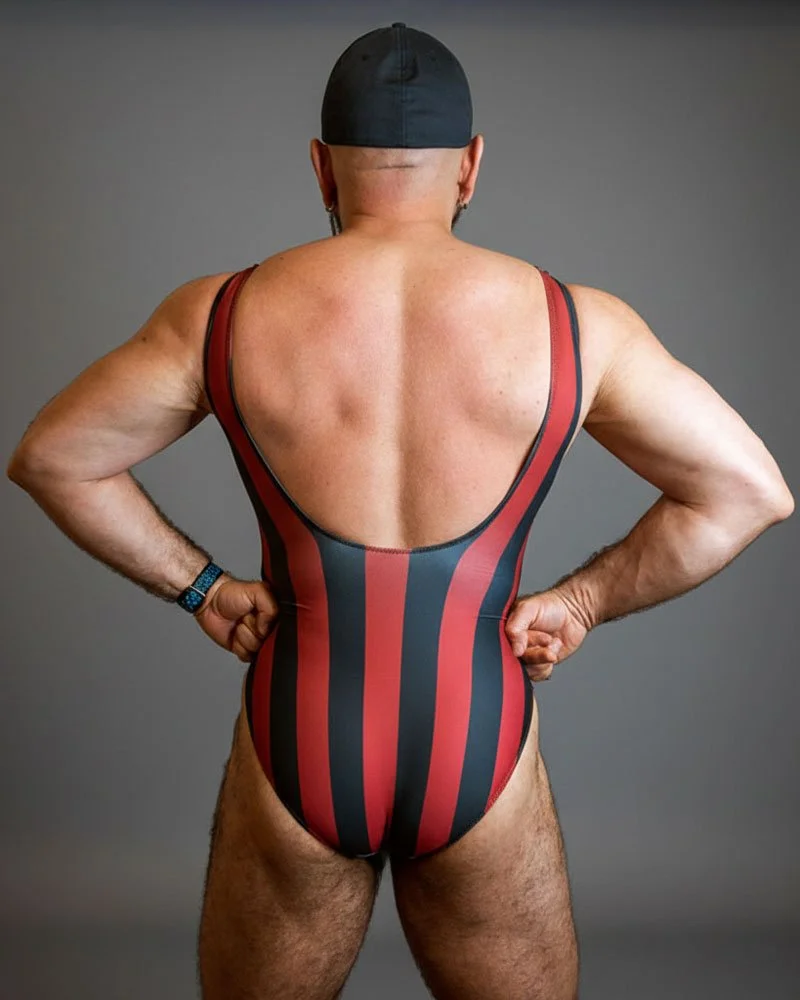
Today, this high-cut singlet has transcended the ring to become a staple of queer fashion, as well as spandex and wrestling fetish. The design persists because it is mathematically the most flattering cut for an athlete's physique—the high leg line elongates the lower body, while the deep side-cuts prevent the "boxy" look common in standard gym wear. By reclaiming this 80s aesthetic, brands like LED Queens are tapping into a "retro-aggressive" movement that also reclaims this garment for queer and gay communities. It’s a nod to a populist sport that has always entertained us with drama, muscle and theater, but one which also appeals intrinsically to those of us who love wrestling and spandex gear as part of our identities.
The "Striped & Scalloped" Honor Roll
Here is a thorough list of the pro wrestlers and luchadores who defined or currently rock the deep-cut, striped, or "Butcher-style" singlet:
Nikita Koloff: The "Russian Nightmare" who mastered the powerhouse singlet look to highlight his incredible traps and lats.
Andre the Giant: The late WWF superstar wore a black single-strap butcher.
Lucha Libre Icons:
Casandro: the most famous of all the “exoticos”
Modern Era:
Otis (WWE): Keeps the "Big Man" striped singlet tradition alive with a classic brawler vibe.
Ryback: His "Big Guy" singlets were a direct 2010s evolution of the 80s airbrushed style.
The LED Queens Relaunch
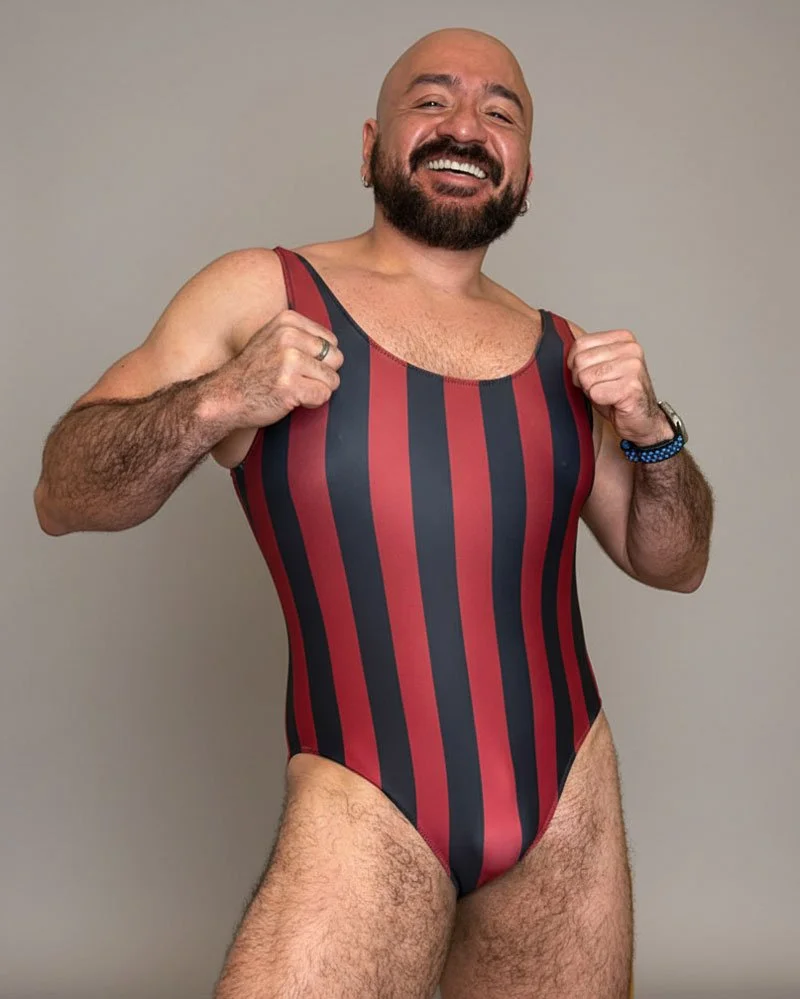
Ten years ago, I launched LED Queens Fitness Apparel as a way to create bold colorful spandex for gay and queer athletes. Over the past decade, the brand has become a destination for those of us who are on this wavelength of queer pride, spandex obsessions, bodybuilding, and also wrestling. I designed some collegiate singlets a few years ago, and they sold out immediately. As a way to respond to demand, in 2026 I launched a new line of butcher wrestling singlets that celebrates our bodies and our passions with myriad colorways that remain bold and queer. At the moment of this blog posts’ publication, we have four unique singlets available, but we will be adding plenty more to the store over the next few weeks.
For me, singlets are a cherished garment. They symbolize my playful nature when it comes to kink and gear, but they also are a reminder that we need to be proud of our bodies. One doesn’t have to look jacked or super muscular to rock a butcher. One just needs encouragement and self love. That’s why I wrote this blog post. It’s from the heart.