Spider-Gwen as a Queer Icon and My Non-Binary Journey
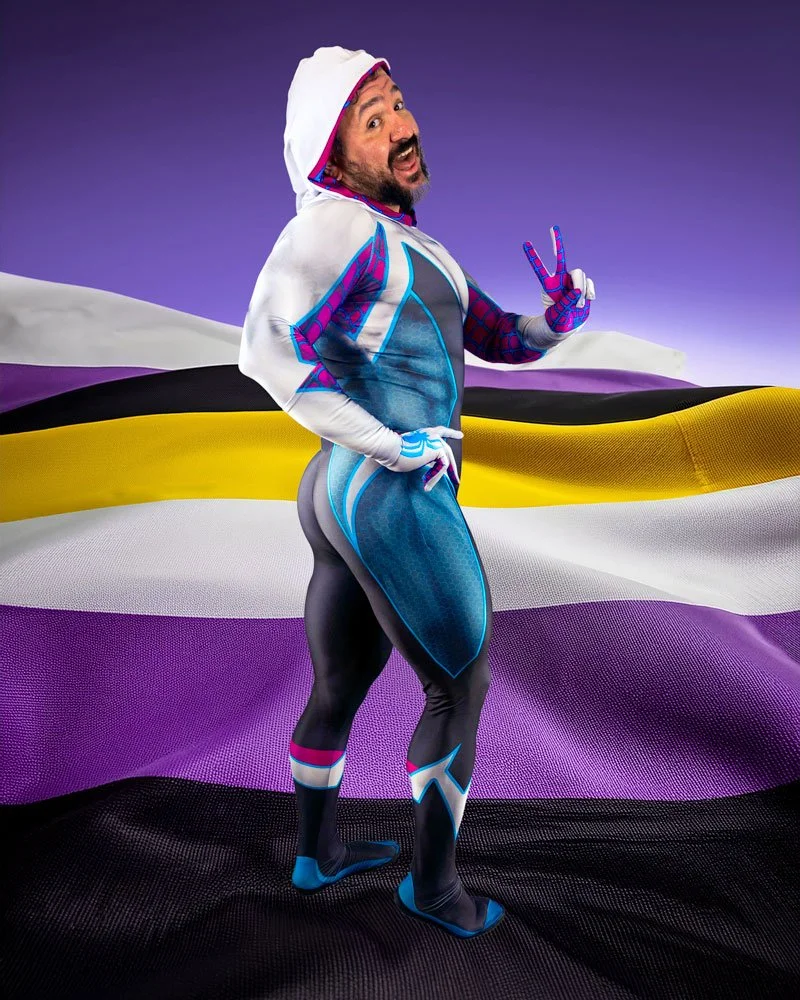
Copyright Cesar Torres, 2025
For queer folks like myself, cosplay allows us to explore and play with gender. In my case, my gender-bent cosplays from my How to Kill a Superhero era helped me define my own non-binary coming out and gender experience.
What Is Non-Binary Gender Identity?
Non-binary gender identity is the umbrella term for the gender identities of people who don’t identify with the sex they were assigned at birth. Non-binary identity falls outside the traditional binary of man or woman, encompassing people who may identify as both, neither, or a fluid mix of genders. While the term has gained significant modern visibility, non-binary identities are not a contemporary "trend"; they have deep historical roots across various cultures, such as the Two-Spirit people in Indigenous North American societies, the Muxe in Mexico, and the Hijra in South Asia, all of whom have recognized third-gender roles for centuries. To represent this diverse community, Kye Rowan designed the non-binary pride flag in 2014, featuring four horizontal stripes: yellow for those whose gender exists outside the binary, white for those with many or all genders, purple for those who feel a mix of male and female, and black for those who identify as agender. In recent years, the visibility of non-binary identities has reached a mainstream peak through influential public figures and artists such as Sam Smith, Demi Lovato, Janelle Monáe, and Utada Hikaru, all of whom have used their platforms to challenge traditional gender norms and advocate for broader social acceptance.
Spider-Gwen Is not Canonically Enby but Is a Queer Icon
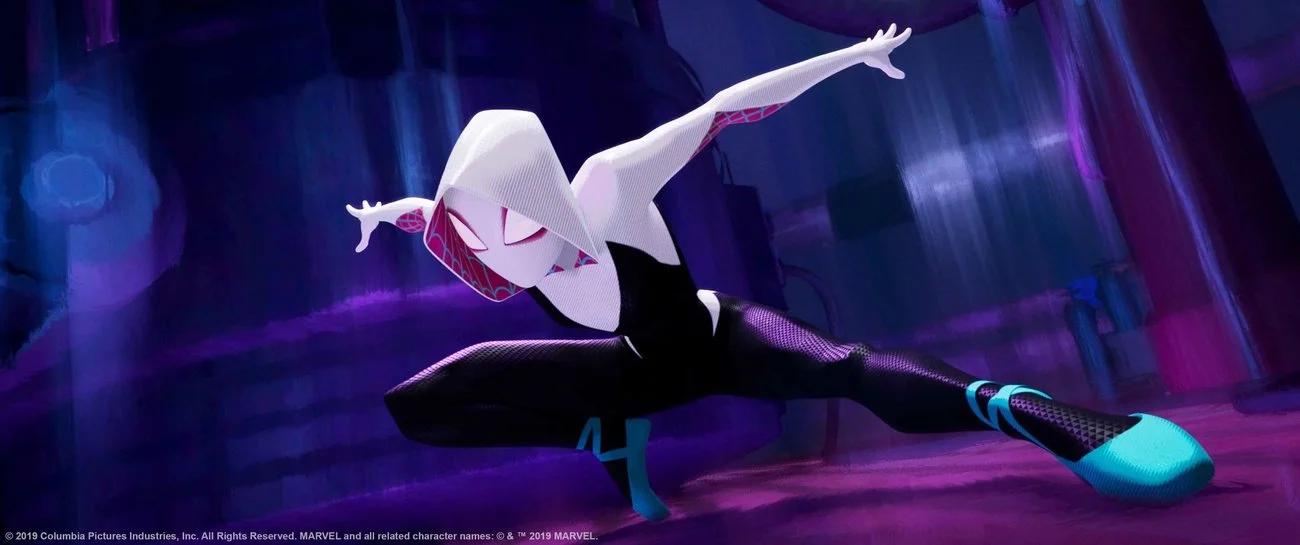
Image via Sony Pictures
While Spider-Gwen (Gwen Stacy) is not canonically non-binary, she has emerged as a powerful queer and transgender icon, particularly following the release of Spider-Man: Across the Spider-Verse. This status is rooted in a rich layer of "queer coding" and visual subtext that many fans interpret as a trans allegory. In the film, Gwen’s private world is adorned with supportive imagery, most notably a "Protect Trans Kids" flag hanging in her bedroom and a trans pride pin on her father’s police uniform. Beyond these physical symbols, the film utilizes a striking color palette of pastel pink, blue, and white—the colors of the Transgender Pride Flag—which wash over the screen during pivotal moments of her character arc. Her narrative journey of hiding a secret identity from her father, the fear of his rejection, and the eventual "coming out" scene where she reveals her true self, mirrors the real-world experiences of many LGBTQ+ youth. By blending these aesthetic choices with themes of self-discovery and familial acceptance, Spider-Gwen has become a symbol of resilience and visibility, allowing queer audiences to see their own struggles and triumphs reflected in a mainstream superhero.
How I Came Out as Non-Binary and Ditched Pablo Greene
During the COVID pandemic, I started to see my gender-bent cosplays in a new way. They expressed what I feel about myself: I have never felt male. Or female. I do know I carry energy of both male and female, but for the most part, I feel that those energies often conflate with culture and societal norms that are often derived from social constructs. If anything, I feel that my gender is something beyond male and female. It’s also why I have always used the word queer to describe myself, since I came out thirty years ago.
As I came to these realizations of my gender, I was also writing a manuscript about a non-binary teen who has to rescue their mother in the jungles of the Yucatan. Though I ended up never publishing that book, the manuscript revealed to me something that was emerging strongly: the need to celebrate my gender identity with pride and no apologies.
As a tertiary outcome, I also stoped using the pen name and public persona Pablo Greene a couple of years ago. I found him to be way too gendered. He no longer fit me. I stayed with the name I was assigned at birth, Cesar. That’s also the name I use on the rest of my published novels. The name itself is gendered, but in everyday life I play with new ways of writing it in a non-binary style. These new variations are XR and CSR. All caps. For now, they work. I do love the name I originally got, but since I don’t feel part of the binary, I would never dream of using the female version of Cesarea. This is jut further proof to me that gender identity for all humans is extremely individualized and must be carefully explored by the self.
The Photo Session
I took this original photo in my Chicago studio with a seamless gray backdrop, but in 2025 I made a new edit with the non-binary pride flag as a new reworking of the project. It brings both the image and my own intent up to date, and let’s face it, a dull gray back drop is boring.
Your Feedback
Got a reaction to this essay and its photo? Send me a note.